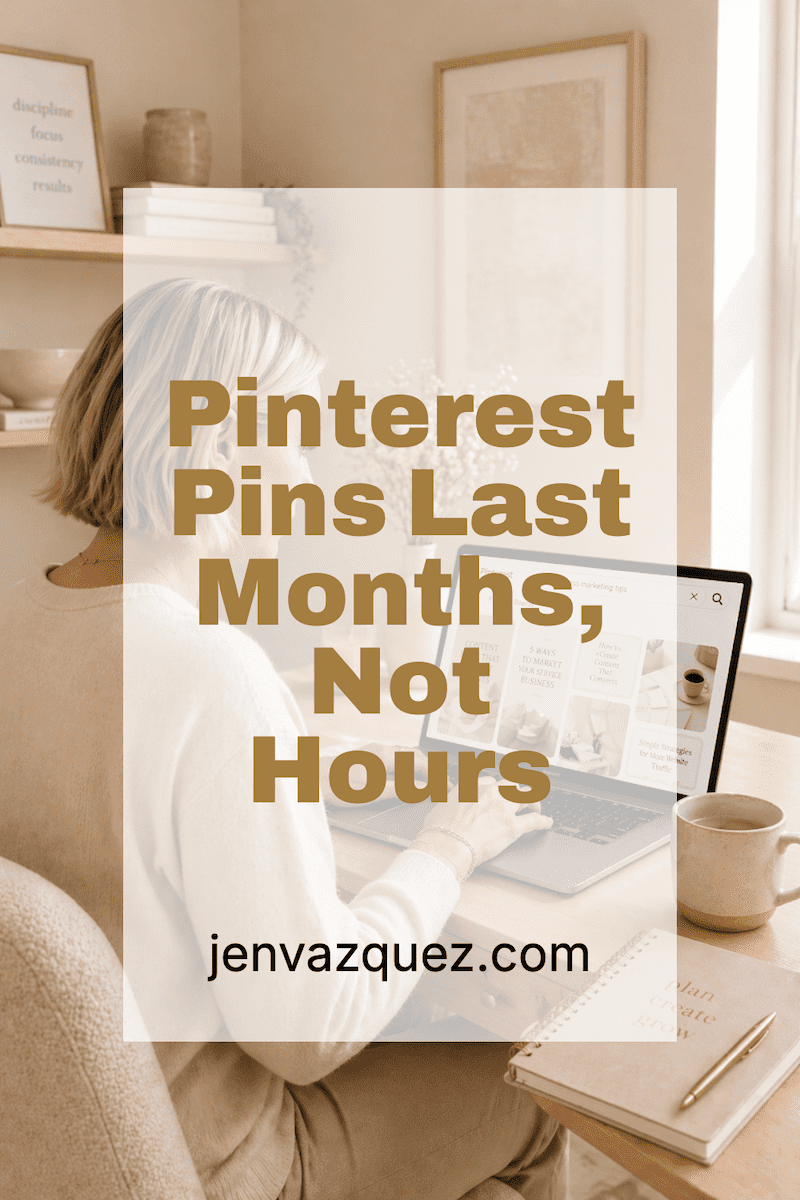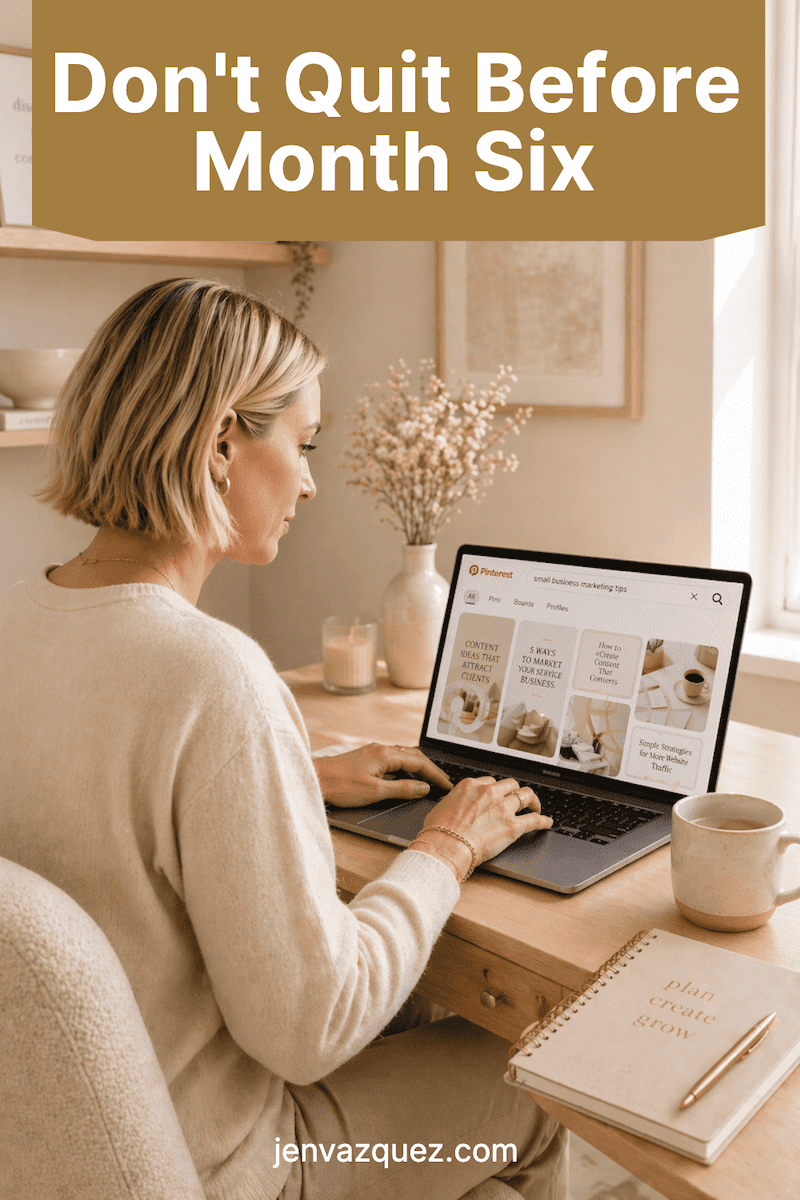
Pinterest Consistency Isn’t About How Much You Pin (It’s About How You Pin)

cozy minimalist morning at a home office. Talking about The Real Reason Your Consistent Pinterest Strategy Isn't Working

Pinterest Consistency Isn’t About How Much You Pin (It’s About How You Pin) 

You’re showing up, you’re pinning consistently, you’re doing everything right, but your Pinterest still feels like it’s going nowhere. Here’s the workflow problem nobody talks about.

You’re being consistent. You’re showing up. You’re pinning. You’re doing everything everyone told you to do.

And your Pinterest still feels like it’s going nowhere.

Here’s what nobody really tells you: consistency on Pinterest isn’t just about how much you pin. It’s about how you pin. And there’s a specific workflow problem that makes even the most consistent pinners invisible.

I’ve been managing Pinterest strategy for service providers for over a decade as a Pinterest Pioneer since 2009, and I see this pattern constantly. Stick with me and I’ll show you exactly what it is.

The Real Consistency Problem

Here’s the thing most Pinterest advice gets wrong: people hear “be consistent,” and they interpret that as posting more.

So they batch 20 pins on Sunday, schedule them all out for the week, and then disappear for two weeks while life happens.

To a human, that feels consistent because you’re doing the work, right?

But to the Pinterest algorithm, that looks like a burst followed by a gap. And every single time you create that gap, your momentum resets all over again.

What Pinterest actually rewards is daily activity. A small, steady signal that says, “This account is active, reliable, and worth surfacing in search results.”

That compounds over time in a way that bursts never do.

Ready to build this workflow with support?

Ready to build this workflow with support? The Club gives you monthly Pinterest trainings, live Q&A, and real accountability to make Pinterest finally work for your service business.

Free Pinterest tools and resources

There are 25+ Pinterest and Marketing tools, templates, education, and more.  Go grab these now!

The Under-One-Hour Weekly Workflow

The workflow I’m about to show you solves this in under an hour a week. Here’s exactly how it works:

Step 1: Content Inventory

Before I even open my scheduling tool, I make a list of everything I want to pin this month:

  • New blog posts
  • New YouTube videos
  • New podcast episodes
  • Evergreen content that’s still relevant and driving traffic
  • Lead magnets I want to push
  • Service pages

For a typical week, I’m working with four to six pieces of content. Each one gets multiple pins, but here’s the important part: different angles for each of those pins.

They’re all going to the same content, but they come at it different ways with different text overlays. Same destination URL. That’s how one piece of content can fuel an entire week.

Step 2: Create the Pins

I create my pins in Canva using brand templates. I use the same color palette (my brand colors), the same font system, just swapping in the headline and image for a different angle, along with a call to action.

For each piece of content, I create three to five variations.

This is where templates save everything. Without them, the under-an-hour thing isn’t true. You have to have a system for that to be reality.

Step 3: Schedule Strategically

Here’s the workflow problem nobody talks about: spacing.

I upload my pins, add titles, keyword-rich descriptions, and destination URLs (don’t forget that call to action), then I drop everything into my Tailwind scheduling queue.

The tool automatically picks the best posting times based on when my audience is most active. You don’t want to publish when nobody’s pinning, and you don’t want to rely on your time zone.

But here’s the critical step most people skip: I check the queue to make sure I’m not scheduling the same URL multiple times in the same week.

Pinterest wants to see your content distributed naturally. If you flood the same link back to back, you’re working against yourself.

Ready to build this workflow with support? The Club gives you monthly Pinterest trainings, live Q&A, and real accountability to make Pinterest finally work for your service business.~ Jen Vazquez

The Difference Between Burst and Consistency

The gap between consistent pinners and burst-and-gap pinners isn’t visible in week one. It shows up at month three when compounding either kicks in or doesn’t.

When Pinterest sees consistent daily activity from your account (even just one or two pins a day), it treats you as an active, reliable creator:

  • It starts surfacing your older content more
  • Your impressions on existing pins go up, even when you haven’t touched them
  • The algorithm recognizes you as trustworthy

When it sees bursts followed by gaps, it treats you as inconsistent:

  • The algorithm starts to pull back
  • Your older content stops getting surfaced
  • You’re essentially starting over every time you come back

That compounding effect that makes Pinterest so powerful for service providers only kicks in for consistent accounts, not for the ones who try hard in bursts.

Why This Workflow Changes Everything

This workflow makes you a consistent account without Pinterest taking over your life. Because I want you to get more out of Pinterest, but I don’t want you to work more.

One hour a week, the queue is filled. Done.

The workflow I just shared is only half the picture, though. If your Pinterest foundation has gaps, this workflow will run perfectly and still not get you clients.

Your profile could be invisible in search. Your board titles might be telling Pinterest the wrong thing. Your top pins might be linking to pages that quietly kill conversions.

Next week, I’m doing a full Pinterest audit covering five things to check before you post another pin. Most people find at least two or three things they didn’t know were broken.

This workflow makes Pinterest work for you instead of the other way around. It builds the daily momentum that creates real, compounding growth.

And when you combine it with a solid foundation, that’s when Pinterest becomes the lead generation engine it’s supposed to be for your service business.

Go introduce yourself on Pinterest, Instagram, or TikTok. I’ll be cheering you on from over here.


DON’T FORGET TO PIN IT!

Why Your Pinterest Isn’t Getting Clicks: 5 Problems Every Service Provider Needs to Fix

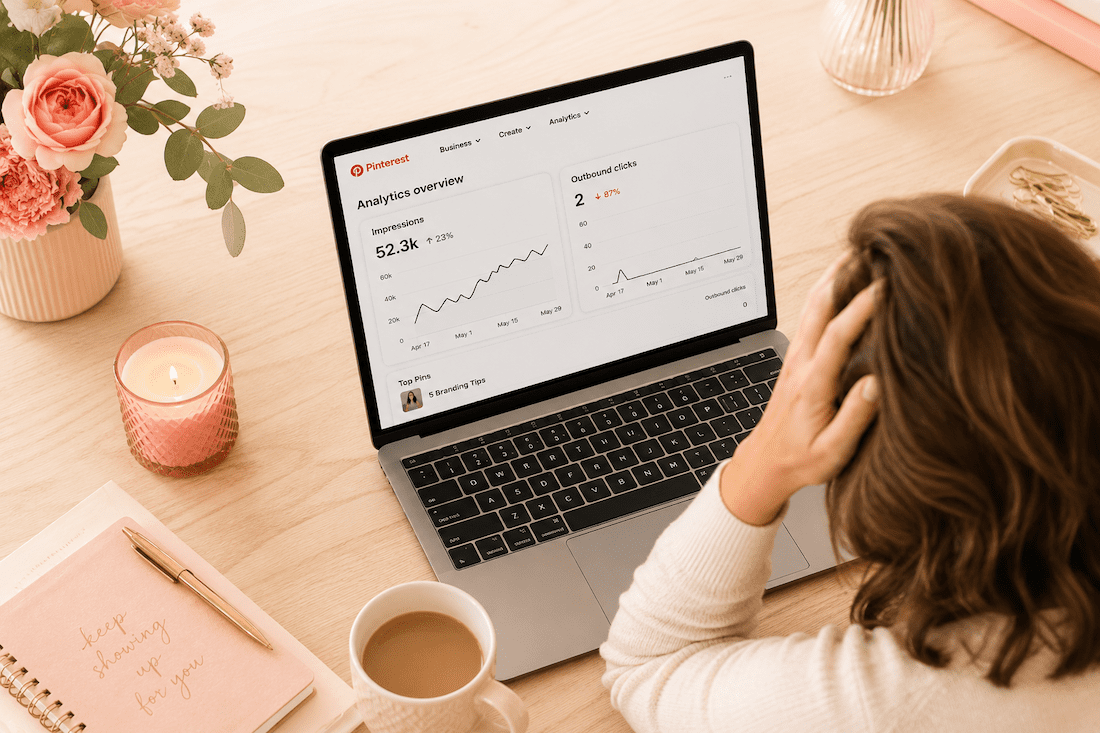
photo of laptop and pinterest analytics on the screen with 0 outbound clicks for a blog: You're pinning consistently but getting zero website clicks? Here are the 5 most common Pinterest problems every service provider faces and exactly how to fix them.

Why Your Pinterest Isn’t Getting Clicks: 5 Problems Every Service Provider Needs to Fix

You’ve been pinning consistently, your boards are set up, and you’re posting regularly – but you’re still getting almost no website clicks. Here’s what’s actually wrong.

You’ve been pinning consistently. Your boards are set up. You’re posting regularly, maybe even writing keyword-rich descriptions.

But you’re still getting almost no clicks to your website.

If that’s you, I want you to know something: it’s not Pinterest, and it’s probably not even your content.

I’ve been on Pinterest since 2009 as a Pinterest Pioneer, back when it was in beta, and I built my photography business using that platform. So when someone comes to me and tells me Pinterest doesn’t work for service providers, I always ask the same question: which of these five things is happening?

Because almost every single click problem comes back to one of these five issues.

Ready to fix your Pinterest strategy?

Get 25+ free Pinterest tools, keyword guides, and templates in the Visibility Vault – specifically built for service providers.

Problem #1: Your Pin Titles Aren’t Triggering the Click

Here’s the most common scenario I see: impressions are decent, maybe 10,000, 20,000, even 50,000 monthly views, but outbound clicks are almost zero.

That’s a packaging problem, not a content problem.

Pinterest is a search engine. People don’t browse it like Instagram – they search, scroll the results, and click on the pin that most promises the best answer. Just like when you scroll on Google.

If your pin title says “My top branding tips,” that’s not a promise – that’s a label.

Compare it to “Five branding tips that helped me book clients at a higher price point.” Same content, completely different click-through rate.

The fix is rewriting your pin titles to lead with a specific outcome, not just a topic.

Problem #2: Wrong Keywords for the Wrong Stage

Not all keywords are equal. Some tell you someone is browsing. Others tell you someone is ready to solve that problem right now.

“Brand photography” is a browse keyword. Millions of people search it. Most are not ready to book.

“What to wear for a brand photoshoot” is a buyer keyword. Someone searching that is actively preparing for a session.

If all your pins target top-of-the-funnel browse keywords, you’ll get impressions from people who aren’t ready to act. Your click rate tanks as a result.

For every broad keyword you use, make sure you have at least one long-tail, intent-specific keyword to speak to someone farther along in the decision.

Problem #3: Your Pin Design Isn’t Stopping the Scroll

Pinterest is visual, and in a sea of vertical images, only certain things stop the scroll.

What doesn’t work:

  • Generic stock photos
  • All-white backgrounds
  • Text that’s too small to read on a phone (where most people search Pinterest)
  • Designs that could be anyone’s

What does work:

  • Faces with direct eye contact
  • Text overlay that states the outcome clearly
  • A color palette consistent enough that people start to recognize your pins over time

Quick audit: pull up your last 10 pins and ask yourself honestly – would you click on them if you saw them while scrolling? If the answer is maybe or no, design needs attention before keyword strategy even matters.

Your Pinterest Strategy, On Repeat

You know Pinterest should be part of your marketing. You just don’t always know what to pin, when to pin it, or if you’re even doing it right. The Club gives you monthly trainings, live Q+A twice a month, two Pinning Sessions to get it done together, and 10 fresh Canva pin templates every month. Plus a community of women who totally get it. All for less than a tank of gas.

Free Pinterest Audit (Live on YouTube)

I’m pulling real Pinterest accounts and reviewing them live on YouTube, so you can see exactly what’s working, what’s not, and what to fix. Apply to have your account chosen. I pick from a mix of industries so even if yours isn’t selected, you’ll still learn something you can use. About 10 accounts per live. Show up, ask questions, take notes. It’s free, it’s real, and it might be exactly what your Pinterest has been missing.

Problem #4: You’re Sending Traffic to a Page That Doesn’t Convert

This one is sneaky. Your Pinterest analytics might actually look okay – impressions up, clicks coming in – but website conversions are zero.

The issue isn’t Pinterest. What happens after the click?

People click with what they think they’re going to see in mind, and they land on your blog post with nothing to do. No clear next steps, no opt-in, no offer. Just content.

Pinterest sends people to your front door. You have to invite them in.

Every single page you’re linking to from Pinterest needs one clear next step: a lead magnet, a discovery call link, a signup form. Pick one, make it obvious, and put it above the fold – meaning at the very top of that landing page.

Problem #5: You Haven’t Given It Enough Time

I know it’s not what you want to hear, but skipping this would be doing you a disservice.

Pinterest is a slow start, strong finish platform.

  • The first two months almost always feel like nothing is happening, and that’s because Pinterest is indexing your content, testing it in small batches, learning who to show it to by the results of what people do in that small batch test.
  • Months three and four: impressions start to rise.
  • Months five and six: clicks start moving.

Beyond that, the compounding effect that Pinterest has kicks in, and the content you built six months ago keeps driving traffic without you lifting a finger.

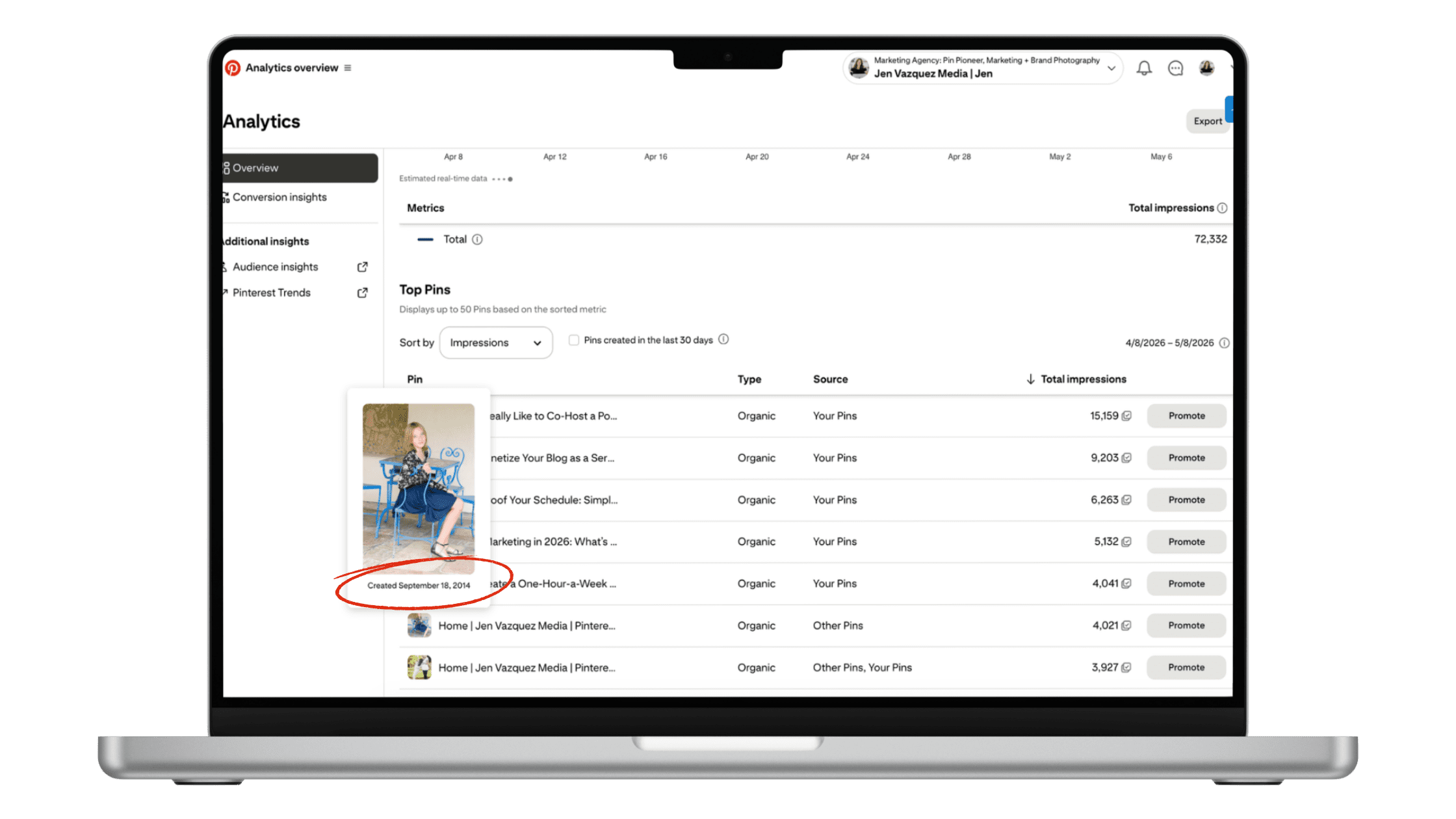
This is an image on a laptop of a Pinterest pin in Pinterest analytics from 2026. The pin is from 2014 and it's still driving traffic 12 years later!

Sometimes, if there’s a topic that’s super popular in search on Pinterest, your pin might take off years later. I have pins I created in 2014 that are still driving traffic today.

Most people quit in month two or three, right before the shift. If you’ve been consistent for less than four months, keep going.

If it’s been six months of real consistency and you’re still seeing zero clicks, something structural needs to change.

It’s a Search Engine

The reality is that Pinterest absolutely works for service providers when you understand it’s a search engine, not a social media platform. But like any platform, there are specific strategies that work and common mistakes that don’t.

These five problems are the most common I see, and they’re also the easiest to fix. Start with whichever one resonated most with your current situation, implement the fix, and give it time to work.

Your future self (and your website traffic) will thank you.

Go introduce yourself on Pinterest, Instagram, or TikTok. I’ll be cheering you on from over here.

📌 DON’T FORGET TO PIN IT!

Why Pinterest Feels Slow and Why That’s a Good Thing for Service Providers

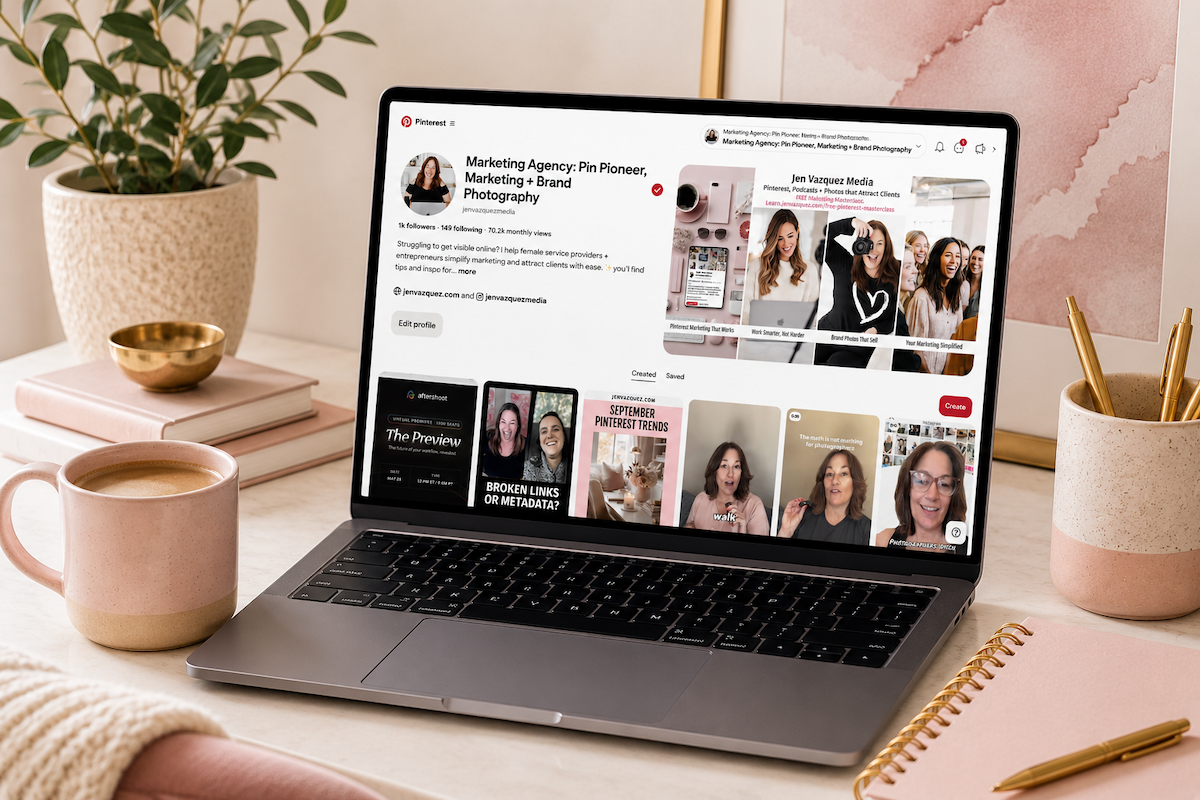
beige feminine office with pinterest on laptop by JVM Stock

Why Pinterest Feels Slow and Why That’s a Good Thing for Service Providers

Quiet Doesn’t Mean Useless. It Means Indexing.

If Pinterest feels slow, it’s not broken. It’s behaving exactly the way it was designed to.

I hear this all the time from service providers who are a few months into Pinterest. They’re posting consistently, they’ve done their keyword research, they’ve set up their boards. And it feels like nothing is happening.

But quiet doesn’t mean useless. Quiet means indexing. And that distinction changes everything about how you approach this platform.

Pinterest Is a Search Engine, Not Social Media

This is the foundation of everything I teach, and it’s especially important when Pinterest feels slow.

Instagram rewards speed. TikTok rewards trends. Pinterest rewards clarity and reputation.

And the difference really matters, because your expectations might be based on the wrong model. If you’re comparing Pinterest to Instagram, you’re measuring a marathon runner by sprint times. They’re completely different sports.

What’s Actually Happening Behind the Scenes

When you publish a pin, Pinterest doesn’t just blast it out to everyone. Here’s what’s actually happening:

  • Pinterest is indexing your keywords
  • It’s testing your content in small batches
  • It’s observing engagement
  • It’s matching your content to search behavior

This process is not instant. It’s layered. And Pinterest content can surface for months and even years. That’s the power.

The Realistic Growth Timeline

Every account is different. Every industry is different. Every business is different. So timing will vary. But here’s the average of what I see:

  • Months 1 and 2: Testing and low visibility. Pinterest is indexing your content and running small test batches. This is completely normal.
  • Months 3 and 4: Increased impressions. You’ll start to see your content getting surfaced more consistently.
  • Months 5 and 6: Click growth. Outbound clicks start moving and website traffic from Pinterest becomes visible.
  • Beyond month 6: Compounding traffic. Old pins resurface. The content library you built keeps driving results without you creating more.

If you quit in month two, you quit before all of that compounding happens. I’ve had pins that take off in the first month, sure. But those aren’t the norm. I’d rather set you up with real expectations so you don’t quit right before the good part.

Why Slow Growth Is Actually Strategic

Here’s a question: have you ever had an Instagram Reel go kind of wild? Huge spike in numbers, feels amazing, and then a deep dive right after?

That’s fast growth. It spikes and crashes.

Slow growth stabilizes. Pinterest builds:

  • Evergreen visibility
  • Consistent referrals
  • Compounding traffic
  • Search authority

It doesn’t depend on trends. It depends on clarity. When you are clear in your marketing, clear on your words, clear on what you’re putting out there, it works. And it works incredibly well.

NEED SUPPORT WHILE YOUR PINTEREST STRATEGY COMPOUNDS? JOIN THE CLUB

If you’re in those early months and want accountability, monthly Pinterest trainings, and live Q+A to keep you going while your content builds momentum, The Club is where I’d love to see you. Join at learn.jenvazquez.com/club.

The Frustrations I Hear (And Why They’re Based on the Wrong Model)

Here are the things I hear all the time:

  • “I’m posting and nothing’s happening.”
  • “My impressions are so low.”
  • “I thought Pinterest was faster.”

Pinterest is faster than Google (I can tell you that). But it is definitely slower than Instagram, because Instagram isn’t about long-term anything. The lifespan of an Instagram post in 2026 is about 26 hours. That’s it.

Pinterest? Three months minimum. Sometimes years.

They are completely different platforms. You cannot compare them. A lot of people put content on Instagram and get instant feedback, comments, likes, and that feels good. But would you trade that for more traffic, more leads, more clients showing up months from now? I would. And I have. That’s why I choose Pinterest.

The Mindset Shift That Changes Everything

If you treat Pinterest like social media, you will be disappointed. I promise.

If you treat it like search infrastructure, you’re going to build momentum. And that mindset shift changes everything in your entire marketing ecosystem.

Pinterest doesn’t reward urgency. It rewards clarity and repetition.

So if Pinterest feels quiet right now, take a breath. Your content is being indexed. Your keywords are being tested. Your visibility is being built, layer by layer.

The good stuff is coming. Stay consistent.

What’s Next

Now that you understand the timeline and why slow is strategic, the next question becomes: how do you build a weekly workflow around this without burning out?

Next week I’m breaking down the simple marketing workflow I use with every single client. I’ll see you then.

Go introduce yourself on Pinterest, Instagram, or TikTok. I’ll be cheering you on from over here! 📣

DON’T FORGET TO PIN IT!

beige feminine office with pinterest on laptop by JVM Stock

Pinterest Analytics for Service Providers: Which Metrics Actually Matter

beige feminine office with Pinterest Analytics on the laptop

Pinterest Analytics for Service Providers: Which Metrics Actually Matter

And Which Ones Are Lying to You

If you’ve been on Pinterest for a few months and you’re not sure if it’s actually working, you’re probably looking at the wrong numbers.

I get it. You open Pinterest analytics, see monthly views going up and down, and think “is this even doing anything?” That’s the most common thing I hear from service providers who are new to the platform.

The truth is, some Pinterest metrics will tell you exactly how your strategy is performing. Others will send you into a spiral for no reason. Let’s sort out which is which.

Before we dig in, make sure you grab my free Visibility Vault at learn.jenvazquez.com/resources. There are over 25 Pinterest + marketing tools inside, and specifically look for the Pinterest Analyzer. It’ll make everything I’m about to share way more actionable.

The Number Everyone Watches (And Misunderstands): Monthly Views

Everyone checks monthly views. And almost everyone misunderstands them.

Monthly views are an impressions metric. It tells you how many times your pin appeared on Pinterest, whether that was in the home feed, in search results, or on someone else’s board. But here’s the thing: just because your pin was served up doesn’t mean anyone actually saw it. It could have appeared on the sixth page of someone’s home feed and never been scrolled to.

These numbers can spike when one pin gets reshared by someone with a larger following. They can drop when Pinterest is testing your new content in small batches. Fluctuations are completely normal and are not a sign that something is broken.

Here’s what I really want you to hear: impressions are not the number that tells you whether your strategy is actually working.

A service provider with 50,000 monthly views and 200 outbound clicks is actually doing worse than someone with 8,000 monthly views and 400 outbound clicks.

Views without clicks do not book you clients.

The Metrics That Actually Matter

Outbound Clicks (The Money Click)

When someone sees your pin in the feed and clicks on it, that’s a pin click. But the outbound click is what happens next. That’s people leaving Pinterest and landing on your website.

This is the metric that most directly connects to leads, signups, and clients. It’s also the last metric to start growing. The order is typically: impressions first, then saves, then pin clicks, then outbound clicks. It can take some months. But even if outbound clicks are growing slowly, your strategy is working.

I like to call outbound clicks the “money click” because you’re that much closer to booking someone. It doesn’t mean they’ll instantly hire you, especially if you have a high-ticket service. But it means there’s enough interest. Your keywords did their job and got you found. Now it’s your chance to nurture that person, whether they grabbed a lead magnet, checked out your services page, or went to follow you on Instagram or TikTok to learn more about you.

Profile Visits

This tells you whether people are finding your pins interesting enough to want to see more of your content. Growing profile visits means growing brand recognition on the platform.

Saves

When someone saves your pin, Pinterest takes that as a very strong signal of relevance. Saves tell the algorithm to keep surfacing your content to similar audiences. A healthy save rate is a really good sign.

Now, saves don’t always mean someone is about to book you. In the wedding industry, for example, it could be a 16-year-old pinning your image to a future wedding board because they love the dress. But what saves do tell you is that Pinterest is indexing your pins properly and sending them out to people. That’s a great signal.

Outbound Click Rate

This is your link clicks divided by your impressions. Even if your monthly views are low, a healthy outbound click rate means the people who are seeing your content are interested enough to act on it.

Quality over quantity, every single time.

What Does a Realistic Growth Timeline Look Like?

This isn’t exact science, but here’s the average of what I see across my service-based business clients:

  • Months 1 and 2: Quiet. Low impressions, low clicks. Pinterest is indexing your content and running small test batches. This is completely normal.
  • Months 3 and 4: Impressions start rising. You might notice one or two pins getting more traction than the rest. Pay attention to those.
  • Months 5 and 6: Link clicks start moving. Website traffic from Pinterest becomes visible in your analytics.
  • Beyond month 6: The compounding effect kicks in. Old pins start to resurface. Traffic builds without you having to create more content. The library you built in months 1 through 6 is now working around the clock.

Most people quit in months two and three. That’s right before the momentum shifts. Stay consistent. I cannot say that enough.

>> WANT HELP UNDERSTANDING YOUR PINTEREST NUMBERS? JOIN THE CLUB <<

Inside The Club, we do live Q+A sessions every month where you can bring your analytics, share your screen, and get real-time feedback on what’s working and what to adjust. Plus monthly trainings to keep your strategy sharp. Join at learn.jenvazquez.com/club.

Using Google Analytics Alongside Pinterest

Pinterest analytics shows you what’s happening on the platform. Your website analytics show you what happens after the click. You need both.

In Google Analytics, look for Pinterest as a traffic source under referral or acquisition data. A heads up: you’ll see multiple Pinterest sources listed (pinterest.com, pinterest.ca, mobile Pinterest, desktop Pinterest). Scroll through all of them and add them up for a more accurate picture.

Also know this: Pinterest analytics and Google Analytics will never perfectly match. They measure things differently. Someone could click an outbound link and immediately close the window. Pinterest counts that as an outbound click, but they never actually loaded your page. Always default to Google Analytics for the most accurate view of who actually made it to your website.

Once you’re in Google Analytics, look at:

  • Which pages Pinterest is sending people to
  • How long they’re staying
  • Whether they’re signing up, clicking to a service page, or booking a call

A click that leads to a five-second bounce is very different from a click that leads to a signup. Knowing which pages convert helps you create more content like the ones that are actually working.

Early Positive Signs to Watch For

Even in the first few months, before link clicks really start moving, there are signs that tell you the foundation is building:

  • One pin consistently getting more impressions than the others. That’s Pinterest telling you it likes that content. Study what’s different about it and create more like it. It could be the image, the colors, or the keywords.
  • Profile visits climbing slowly. People are discovering you and wanting to see more. That’s brand recognition growing.
  • Saves increasing on a specific board. That topic is resonating. Lean into it.

Marketing is all about testing. If a pin takes off, make more pins for a different blog using the same keyword approach. Or go back to a blog from two months ago and create fresh pins for it. Test the same keywords, test different colors, test different images. The goal is to figure out what’s driving those impressions and do more of it.

Here’s a bonus tip: sometimes your pin will stand out because it’s visually different from the feed. If you search for anything wedding-related on Pinterest, the entire feed is pastel. When I was a wedding photographer, I’d make pins with a black background and white text, or use my bright pink brand color, specifically to stand out in that sea of pastels.

When Should You Actually Adjust Your Strategy?

The biggest mistake I see is people pivoting too early. They’ll be three months in, assume something’s wrong, and change their strategy. That throws you right back into Pinterest’s testing phase, and you lose all the momentum you were building.

Pick a strategy. Move forward. Don’t change it for at least three to four months.

If after six solid months of consistent pinning you’re still seeing zero outbound clicks and no website traffic from Pinterest, that’s when something may need to change. But it’s usually one of these four things:

Keyword Gaps

Your content exists but isn’t optimized for what your ideal client is actually searching for. Go back to keyword research and update your pin titles and descriptions.

Content Mismatch

What you’re creating isn’t what your ideal client is looking for on Pinterest. Look at which pins are getting saved and lean into those topics.

Destination Problems

Your pins are getting clicks, but people are bouncing fast. The page they land on doesn’t deliver on what the pin promised, or there’s no clear next step. Think about what someone sees above the fold on your landing page. If that doesn’t pull them in, there’s nothing Pinterest can do about it. Fix the landing page.

Inconsistency

Posting 20 pins in one week and then disappearing for three weeks breaks the compounding pattern and sends signals to Pinterest that you’re not trustworthy. Steady and consistent always beats bursts followed by gaps.

Don’t Have Time to Manage All of This Yourself?

If you’ve been watching this series and thinking “this sounds great but I genuinely do not have time to manage all of this,” that is literally what my agency does.

We manage Pinterest for service providers who want the results without doing it all themselves. We handle the strategy, the pinning, the scheduling, all of it.

>> BOOK A DISCOVERY CALL <<

What’s Coming Next

One thing that dramatically improves Pinterest performance is having brand images that actually stop the scroll. Not just on Pinterest, but everywhere. The visual matters a lot, especially on a search engine that’s built around images.

Next week I’m talking about how brand photography fits into your entire marketing system, including how to plan your next photo session so you always have Pinterest-ready content to work with.

Go introduce yourself on Pinterest, Instagram, or TikTok. I’ll be cheering you on from over here! 📣

How to Find + Use Pinterest Keywords That Actually Get Your Content Found

image of a feminine pink office with a laptop and on the screen is a video of How to Find + Use Pinterest Keywords That Actually Get Your Content Found.

How to Find + Use Pinterest Keywords That Actually Get Your Content Found

The Foundational Skill Every Service Provider Needs on Pinterest

If your content isn’t showing up on Pinterest, keywords are probably why.

The good news? Pinterest actually makes keyword research easier than almost any other platform. You just have to know where to look.

Keywords are the skill that makes everything else on Pinterest actually work. Without the right keywords, your pins exist, but nobody can find them. With the right keywords, your content shows up in front of exactly the right people consistently over time.

Before we proceed, I want to ensure you’re aware of my free resource library, the Visibility Vault. It has Pinterest tools, marketing tools, a masterclass, keyword resources, and marketing templates, over 25 different tools, all free at learn.jenvazquez.com/resources. Go grab it and follow along.

Why Keywords Matter on Pinterest

Pinterest is a search engine, and like any search engine, it relies on keywords to understand what your content is about and who to show it to.

So when someone types “how to get more clients as a photographer” into Pinterest, the platform scans billions of pieces of content and decides which ones match that search.

If your content doesn’t include that language, you’re invisible for that entire search. If it does, you have a chance to show up and keep showing up for months, and oftentimes for years.

Where to Find Keywords: The Pinterest Search Bar

The fastest and most reliable way to find Pinterest keywords is in the Pinterest search bar itself. Here’s how:

  • Go to Pinterest and click the search bar
  • Type in a broad topic related to your business
  • Before you even hit enter, Pinterest will start suggesting completions (just like Google)

Those suggestions are real searches that real people are typing in right now. And they’re typically listed in order of search volume.

Here’s an example. Type in “brand photography” and you might see:

  • brand photography ideas for small business
  • brand photography tips
  • brand photography poses
  • brand photography flat lay

Those are your keywords. Now hit enter and you’ll see colored tiles or bubbles appear right underneath the search bar. Those are Pinterest’s guided search categories. They show you exactly how people are narrowing their searches.

Screenshot them all. Or write them down on a keyword builder. This is free keyword research built right into the platform.

Secondary Research: Look at Performing Pins

Find a pin in your niche that is performing well. High saves, good engagement, and lots of outbound clicks are what I look at.

Read the title and description carefully. What words are they using? What phrases keep showing up?

This isn’t about copying. It’s about understanding what language is already working so you can use it authentically in your own content.

If you’ve been posting nonstop and still wondering “where are the clients?”… you’re not alone.

The problem isn’t your effort—it’s where you’re putting it.

Social media content fades fast.
Search-based content builds over time.

In this free live masterclass, Search vs. Social: Build a Visibility System That Brings Consistent Leads, you’ll learn how to stop chasing daily posts and start creating content that actually works for you long-term.

We’ll break down how Pinterest + SEO work together to bring in steady traffic and leads—without the constant grind.

If you’re tired of spinning your wheels and ready for a smarter, simpler way to get found… this is for you.

Where to Put Your Keywords

Finding keywords is only half of it. Placement is what activates them. Here are the 7 places your keywords need to live:

1. Your Display Name

Keywords in your name help Pinterest understand what you’re about from the jump.

2. Your Bio

Write it using the language your ideal client would search, not your job description. Their search terms are a win for you every time.

3. Board Titles

Every board title is indexed. Name boards the way your ideal client would actually type into the search bar, not the way you’d label a folder.

4. Board Descriptions

Two to three sentences per board using your keywords naturally. Think human-read paragraphs, not a list of terms stuffed together. Keyword dumping looks spammy and can hurt your ability to get found.

5. Pin Titles

This is one of the most important spots. Lead with your keyword phrase. Something like “Pinterest Marketing Tips for Service Providers: How to Get Started.”

6. Pin Descriptions

Two to four sentences. Use your primary keyword plus one or two related phrases. Write it like a human. The keywords should be clearly there, not forced.

7. The Content You Link To

If your blog post title and headings also use those keywords, Pinterest gets even more signals that your content matches the search. Everything reinforces everything else.

>> WANT ONGOING PINTEREST SUPPORT? JOIN THE CLUB <<

If you want monthly Pinterest trainings, live Q+A sessions, and a place to actually ask your keyword questions in real time, The Club is where I drop all of it. Come hang out at learn.jenvazquez.com/club.

How Much Is Too Much? Avoiding Keyword Stuffing

A common mistake is keyword stuffing, which means cramming in as many keywords as possible until the description reads like a robot wrote it.

Pinterest is smart enough to catch this, and it does not help your ranking at all.

The goal is natural language that includes your keywords intentionally. Read your pin description out loud. If it sounds weird, rewrite it. Real humans write it. Keywords support it. That’s the balance.

Local vs. Global Keywords

This is especially important for local service providers like photographers, wedding planners, coaches, or fitness pros serving a specific area.

Use both. Here’s why:

  • Global keywords like “brand photography tips” reach a broad audience and can drive referrals or education sales
  • Local keywords like “brand photographer San Jose” or “brand photographer Bay Area” reach people actively looking to book locally

I see a lot of local service providers using only generic keywords, and that’s not going to be enough to grow your business. I did this right from the beginning, and I think that’s what made a difference for me growing my business on Pinterest.

Local keywords also work for people who are traveling to your area. Someone in New York planning a trip to San Jose might search for a photographer in San Jose. If you’re using local keywords, you get found by people all over the world who come to your area.

Both serve a purpose. If you only use local, you’re missing out on the general searches that could really help you. Build your keyword strategy to include both. It’s your best chance at the fastest growth on Pinterest.

How Often Should You Revisit Keyword Research?

Keyword research is not a one-and-done task. Do a refresh every three to six months.

Search behavior changes. New terms emerge. What your ideal client is searching for in January might be slightly different by summer. Stay updated and keep your content compounding instead of plateauing.

Keywords are how Pinterest finds your content. Get them right, and your pins will keep working long after you publish them.

What to Learn Next

Now that you know how to build your strategy and how to use keywords, the next question I hear all the time is: how do I actually know if any of this is working?

That’s exactly what we’re covering next week. I’ll break down which Pinterest numbers actually matter, which ones are misleading, and what a healthy growth timeline really looks like so you don’t quit right before the good stuff happens.

Go introduce yourself on Pinterest, Instagram, or TikTok. I’ll be cheering you on from over here! 📣

📌 DON’T FORGET TO SAVE IT!

Why You Need to Join the Pinterest Business Community (PBC)

An image of the Pinterest Business Community

Why You Need to Join the Pinterest Business Community (PBC)

If you’re using Pinterest for your business, this free community might be the best-kept secret you’re sleeping on.

Okay, real talk. When I first started using Pinterest to grow my photography business back in 2009, I was pretty much winging it. There wasn’t a whole community of business owners talking strategy, sharing what was working, or helping each other troubleshoot. You just… figured it out alone.

That’s why I’m genuinely excited every time I get to tell someone about the Pinterest Business Community — because it’s the resource I wish had existed when I was starting out.

Let me break down what it is and why you should be in there.

What Is the Pinterest Business Community?

The Pinterest Business Community (PBC) officially launched in 2019 as a dedicated space for creators, business owners, and marketers to connect, ask questions, and share real Pinterest strategies that actually work.

It’s not a Facebook group. It’s not just another place to dump your links and hope someone clicks. It’s an actual community run by Pinterest, designed to help you level up how you’re using the platform for your business.

Whether you’re brand new to Pinterest or you’ve been pinning for years, there’s always something to learn and someone to connect with.

Why You Should Join the PBC

You’ll finally have people to talk Pinterest with.

If you’re like most of my clients, you’re surrounded by people who either don’t use Pinterest at all or who use it the way everyone does — casually scrolling for recipes and home inspo. The PBC is full of business owners who are using Pinterest with purpose. To grow visibility, drive traffic, and bring in leads without relying on social media alone. That’s your people.

You’ll get real answers to real questions.

The PBC already has tons of helpful conversations about topics like product pins, video pins, SEO strategy, pin design, and more. You can search by topic or just browse what other members are talking about. And if you have a question that isn’t answered yet? Ask it. That’s the whole point.

You’ll get behind-the-scenes info that isn’t always shared elsewhere.

One of the best things about the PBC is that you’ll find platform updates and insights that don’t always make it into your regular news feed. When Pinterest makes changes (and they do), the PBC is usually one of the first places those conversations happen.

Want Expert Help?

The Club is Jen’s monthly membership with live coaching, fresh strategy, and a community of female service providers who are done winging it. The Club is a monthly membership you can join and stop at anytime.

You can make a real difference for someone else.

Here’s something I really love about this community. If you’ve been using Pinterest for a while and you’ve figured some things out, you have the ability to help someone who’s just starting. Sharing what you know and helping another business owner avoid the mistakes you made? That’s a good use of five minutes.

How to Get Started

If you’re new to the PBC, here’s where I’d start:

Check out the Community Guidelines first to learn about how things work. The vibe is helpful conversations, not self-promotion, and that’s actually what makes it so good.

Head to the Introduce Yourself section and share what you do. People do connect and network in there, so don’t skip this step.

Keep your PBC profile updated so other members can find you, know what you’re about, and reach out if there’s a connection to be made.

And honestly? Don’t be shy. Ask your questions, share your wins, jump into conversations. That’s how you get the most out of it.

One Last Thing

Pinterest is a search engine, not social media. The strategies that work here are different from what you’re doing on Instagram or TikTok. Join the free community with other businesses using Pinterest.  Don’t forget to say “Hi!” to me!

Go introduce yourself on Pinterest, Instagram, or TikTok. I’ll be cheering you on from over here! 📣


📌 DON’T FORGET TO PIN IT!

graphic with words The Free Pinterest Community You Are Missing