Pinterest Audit: 5 Things to Check Before You Post Another Pin
You’ve been consistent. You’ve been showing up. You’ve been posting regularly, doing all the things.  And you’re still not getting the clients you want from Pinterest.

I want to say something before we dive into this: that’s not a reflection of your effort.  It almost always comes down to five specific things that are very fixable. And one of them surprises almost everyone because they assume it doesn’t matter.

I’m a Pinterest Pioneer, and I’ve audited hundreds of Pinterest accounts. This is the exact checklist I run on every single one. Pull up your Pinterest account and follow along, because I’m going to walk you through each audit item so you can spot-check your own account right now.

Audit #1: Your Profile Is Invisible in Search

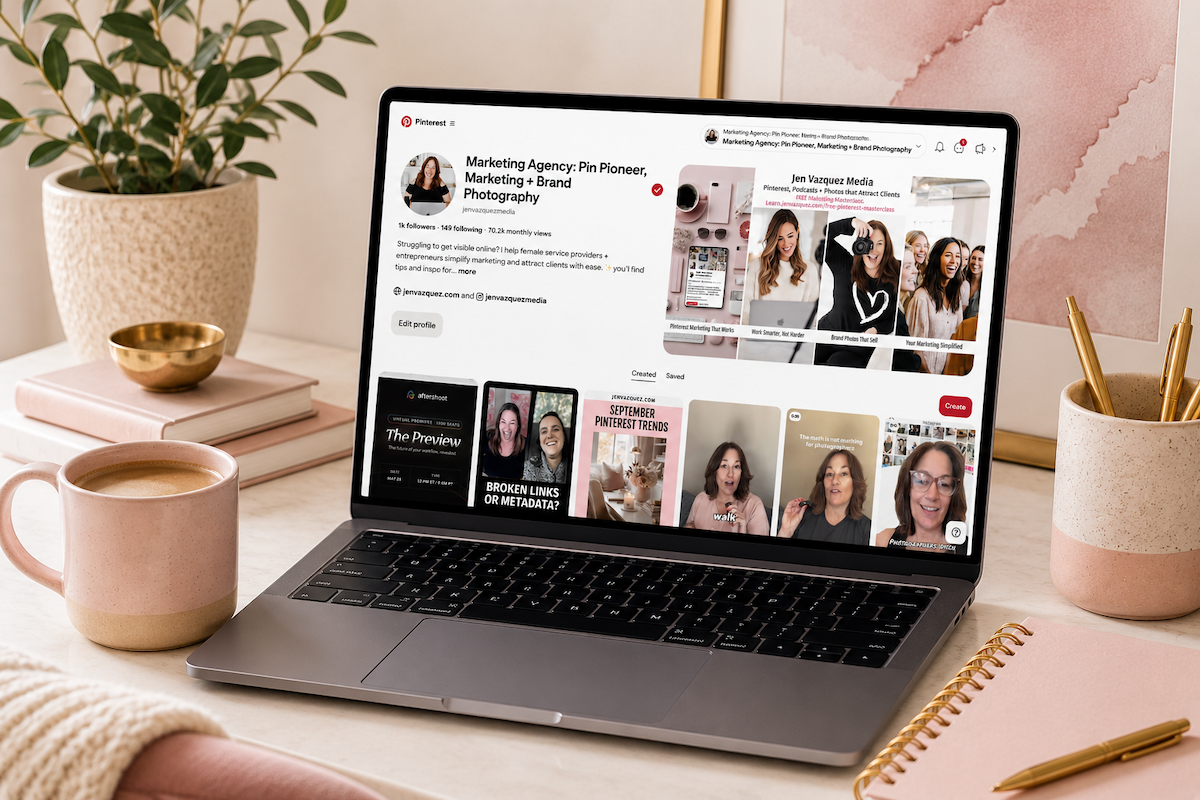
Open your Pinterest profile and look at your display name and bio.

Your display name should include your name and a keyword or two, not just your business name. Something like “Jen, brand photographer for female service providers.”

The more specific you are, the more Pinterest understands who you are and who you serve, and it will serve your content up to the appropriate people.

Pinterest indexes that display name as one of its first signals about who you are.

Your bio should read like the answer to “what do you do and who do you help,” but written the way your ideal client would describe it or type it into a search bar on Pinterest. Not the way you would introduce yourself at a networking event.

Red flag: If your bio says “Photographer, mama, coffee lover,” that’s Instagram thinking. This is a search engine, so we want to be specific.

Audit #2: The Surprise – Board Descriptions

This is the one that really surprises people.

Most people have either no board description at all or board titles named for themselves with cute names instead of for search. “My Faves” or “Good Eats” does absolutely nothing for you.

“Pinterest marketing tips for female service providers” gets indexed.

Every board title and every board description is a signal to Pinterest about what your account is all about and who to show your content to. This is why you want to be specific.

Here’s part of the problem: Pinterest doesn’t require you to add a board description. It only forces you to create a board title.

To enter that board description, you have to click on that board, click on the three dots on the top right, and edit that board. Then you can enter your board description.

You want to add a full, human-readable description of that board and what people will find there. Two to three sentences per board. You want to enter enough description that Pinterest knows who it’s for, but not so much that it’s just keyword, comma, keyword, comma, keyword.

Board count check: If you have more than 40 boards, it usually means the account is scattered and not defined and specific enough. Eight to 20 focused, relevant boards outperform 50 random boards consistently.

If you haven’t pinned to a board in more than six months, consider merging it with another board.

Pinterest Clean-up or Set-up

Ready to give your Pinterest a total refresh, but know that you don’t want to do the work? Rather have an expert do it? The Pinfluence Power Clean is for you!  It’s a 21-day done-for-you Pinterest overhaul — SEO updates, optimized boards, pin templates, and a strategy call all included.

FREE 3-Minute Pinterest Audits

I’m doing Pinterest Audits on YouTube LIVE. Whether you sign up to have your account audited or you just watch, you will still learn things that will help your account.  When I audit accounts, I’ll give multiple things you can do to optimize your Pinterest account. Fill out the form by clicking the button.

Pinterest Audit + Strategy Calls

Your Pinterest Could Be Bringing You Clients Right Now. If it’s not, something’s off. A Pinterest Audit gives you a personalized look at exactly what’s working, what’s not, and a clear action plan to fix it fast.

Audit #3: Your Pin Titles Are Labels, Not Promises

Pull up your five most recent pins and read the titles out loud.

Do they include a keyword phrase that your ideal client would search on Pinterest or Google? Do they make a specific promise? Would you actually click them if you saw them while scrolling?

Weak: “My process”
Strong: “How I plan a brand photo session around your marketing calendar”

Do you see the difference?

Weak: “Tips for coaches”
Strong: “How to get more coaching clients using Pinterest without posting every day”

The title is the first thing the algorithm reads and the first thing a human reads. It has to earn the click before anything else matters.

Audit #4: The Sneaky One – Links

Click the URLs in your five most recent pins and see what actually happens.

When you get there, does the page deliver on what you promised in the pin? Is there a clear next step – an opt-in, booking link, service page – or does it just go to your homepage with no direction?

Pinterest gets people to your front door. If there’s nothing inviting them inside, they’re going to leave and you’ll never know they were there.

When a person leaves Pinterest and immediately comes back to Pinterest, that’s a sign to Pinterest that the content wasn’t trustworthy, and they may throttle back on serving that content to other people.

Also, check for broken links. This happens more than people think, especially after website redesigns, and it quietly destroys your credibility with Pinterest’s algorithm.

Audit #5: The Money Metric

Monthly views feel like progress. You see that number climbing, and it feels like the metric you should be chasing.

Outbound clicks are what actually become clients.

Most people are optimizing for the wrong number and wondering why Pinterest isn’t working.

Go into Pinterest Analytics, look at your top-performing pins from the last 90 days, and sort by outbound clicks. Not by impressions, not by saves – outbound clicks.

That number represents people leaving Pinterest and landing on your website. It’s the metric most directly connected to leads, email signups, discovery calls, and clients.

Monthly views tell you how many times your pin showed up somewhere on Pinterest. Outbound clicks tell you how many people cared enough to act.

A service provider with 8,000 monthly views and 400 outbound clicks is doing better than one with 80,000 monthly views and 40 clicks every single time.

Look at what content is generating those clicks. What topics, what formats, what keywords? Are you creating more of those, or are you still pinning at random?

If you have impressions but no clicks: It’s probably a packaging or keyword problem (back to items two and three).

If you have clicks but no conversions: The destination is the problem. Work on that landing page.

If you have nothing: It may be a consistency or timing issue. Keep going and audit again in 60 days.

What to Do Next

Here’s the truth: consistent posting without a solid foundation is just creating more of the same result. Fix the foundation first.

If you ran through that audit and found more than one or two things that need fixing, you’re not alone. Most accounts I audit have at least a few of these issues.

The good news? They’re all fixable.

Even a perfect Pinterest strategy can only work as hard as your visuals allow it to. If your images aren’t stopping the scroll, none of the keywords matter.

Next week, I’m going deep on how to plan a brand photography session around your content calendar so you never start from scratch again, how to repurpose brand images on Pinterest, and how the right visual library completely changes how easy your whole marketing workflow feels.

Your Pinterest foundation matters more than how much you pin. Get these five things right, and everything else gets easier.

Go introduce yourself on Pinterest, Instagram, or TikTok. I’ll be cheering you on from over here.

📌 DON’T FORGET TO PIN IT!

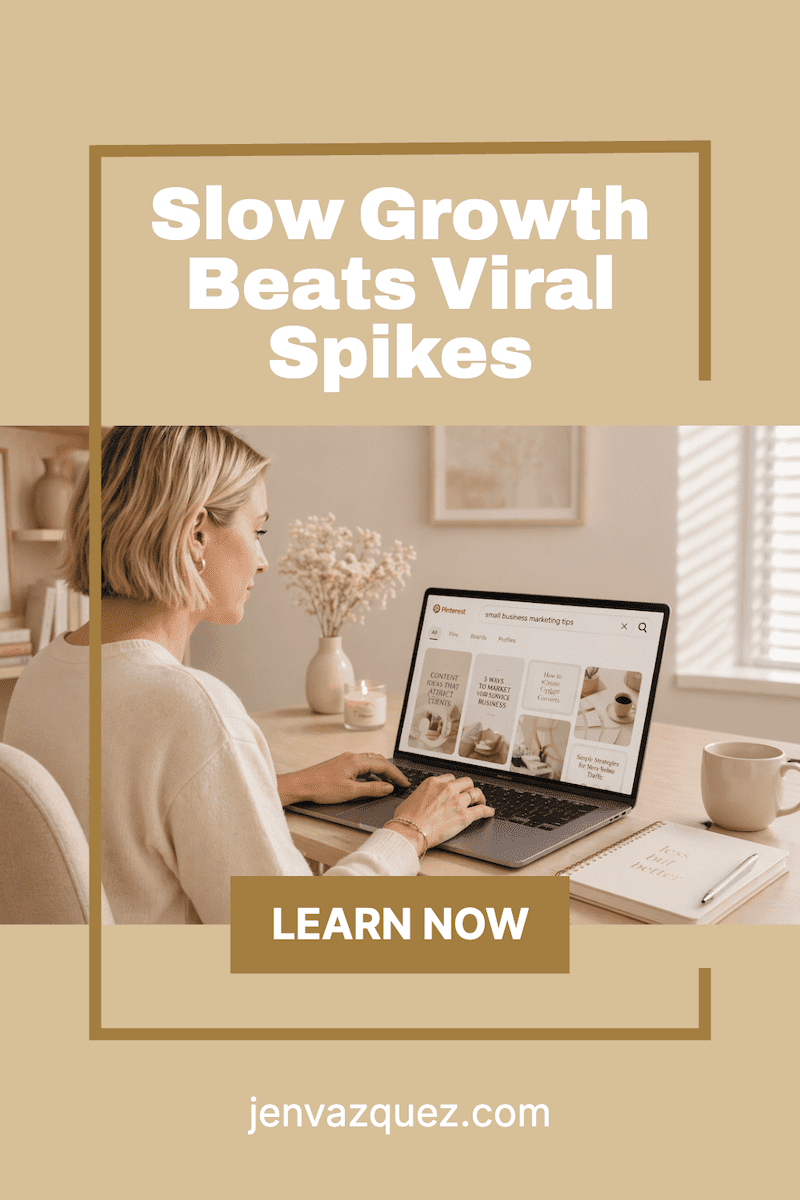
Why Pinterest Feels Slow and Why That’s a Good Thing for Service Providers

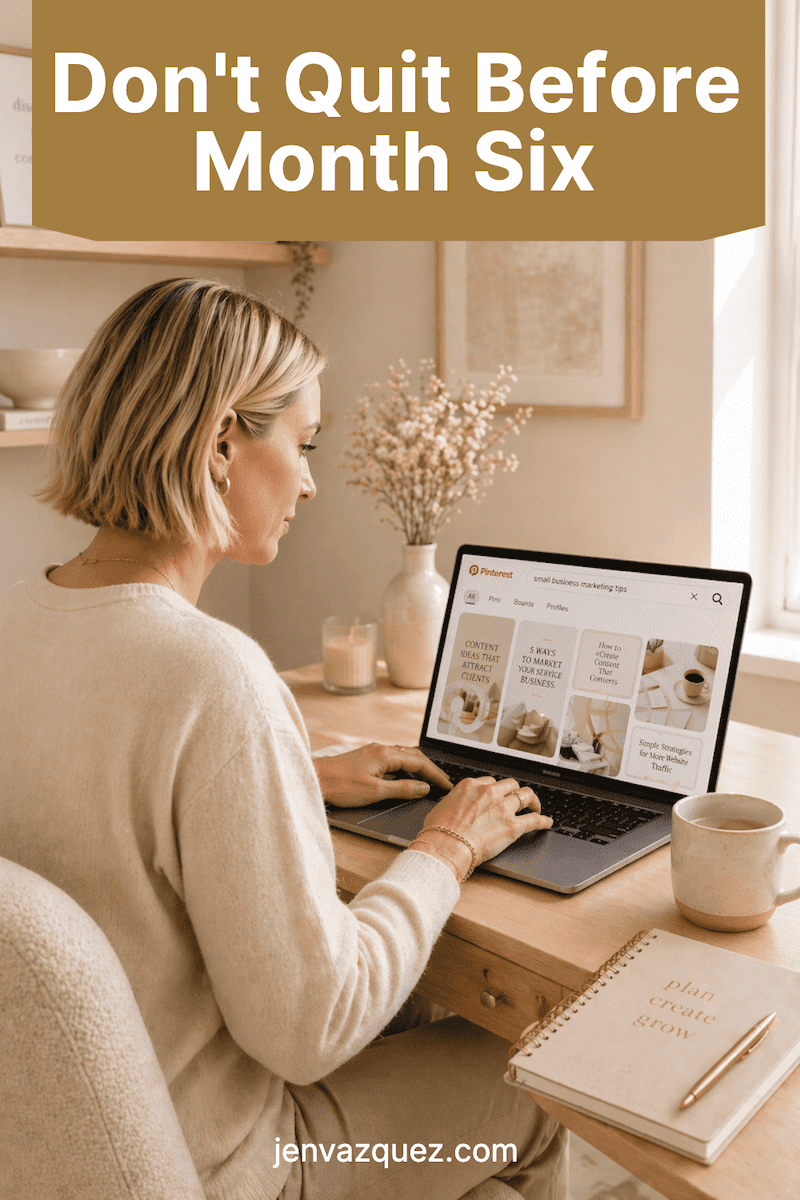
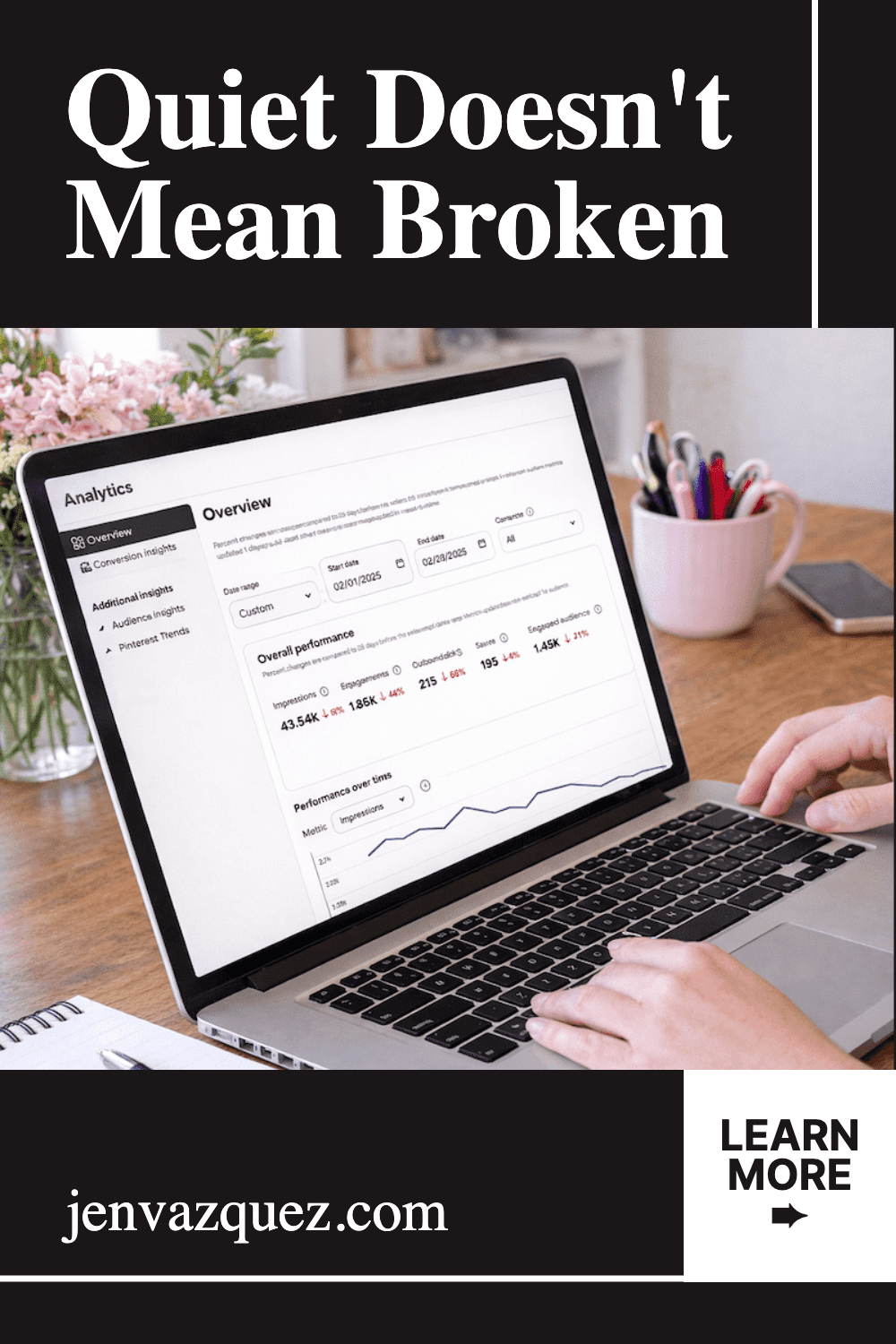
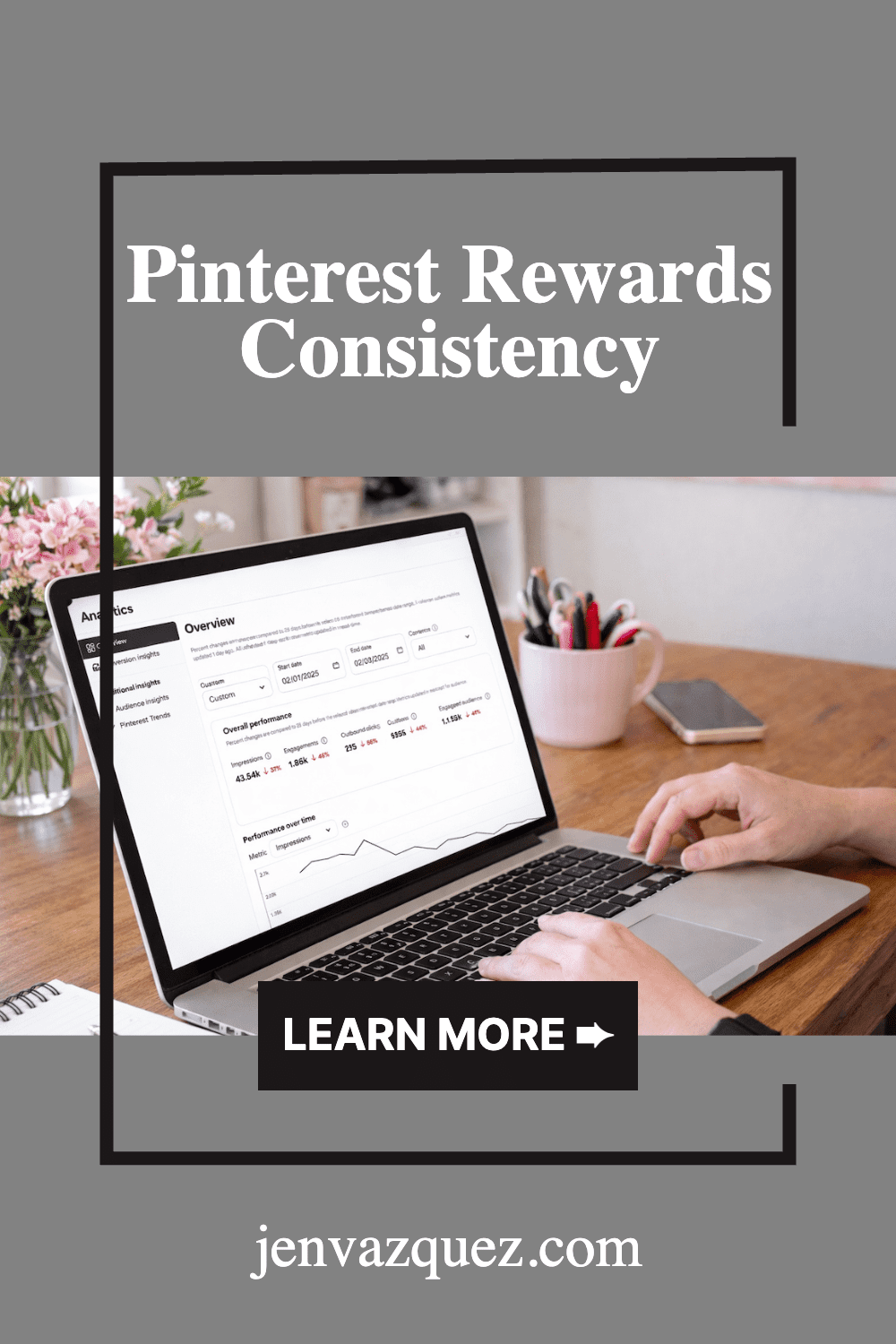
beige feminine office with pinterest on laptop by JVM Stock

Why Pinterest Feels Slow and Why That’s a Good Thing for Service Providers

Quiet Doesn’t Mean Useless. It Means Indexing.

If Pinterest feels slow, it’s not broken. It’s behaving exactly the way it was designed to.

I hear this all the time from service providers who are a few months into Pinterest. They’re posting consistently, they’ve done their keyword research, they’ve set up their boards. And it feels like nothing is happening.

But quiet doesn’t mean useless. Quiet means indexing. And that distinction changes everything about how you approach this platform.

Pinterest Is a Search Engine, Not Social Media

This is the foundation of everything I teach, and it’s especially important when Pinterest feels slow.

Instagram rewards speed. TikTok rewards trends. Pinterest rewards clarity and reputation.

And the difference really matters, because your expectations might be based on the wrong model. If you’re comparing Pinterest to Instagram, you’re measuring a marathon runner by sprint times. They’re completely different sports.

What’s Actually Happening Behind the Scenes

When you publish a pin, Pinterest doesn’t just blast it out to everyone. Here’s what’s actually happening:

  • Pinterest is indexing your keywords
  • It’s testing your content in small batches
  • It’s observing engagement
  • It’s matching your content to search behavior

This process is not instant. It’s layered. And Pinterest content can surface for months and even years. That’s the power.

The Realistic Growth Timeline

Every account is different. Every industry is different. Every business is different. So timing will vary. But here’s the average of what I see:

  • Months 1 and 2: Testing and low visibility. Pinterest is indexing your content and running small test batches. This is completely normal.
  • Months 3 and 4: Increased impressions. You’ll start to see your content getting surfaced more consistently.
  • Months 5 and 6: Click growth. Outbound clicks start moving and website traffic from Pinterest becomes visible.
  • Beyond month 6: Compounding traffic. Old pins resurface. The content library you built keeps driving results without you creating more.

If you quit in month two, you quit before all of that compounding happens. I’ve had pins that take off in the first month, sure. But those aren’t the norm. I’d rather set you up with real expectations so you don’t quit right before the good part.

Why Slow Growth Is Actually Strategic

Here’s a question: have you ever had an Instagram Reel go kind of wild? Huge spike in numbers, feels amazing, and then a deep dive right after?

That’s fast growth. It spikes and crashes.

Slow growth stabilizes. Pinterest builds:

  • Evergreen visibility
  • Consistent referrals
  • Compounding traffic
  • Search authority

It doesn’t depend on trends. It depends on clarity. When you are clear in your marketing, clear on your words, clear on what you’re putting out there, it works. And it works incredibly well.

NEED SUPPORT WHILE YOUR PINTEREST STRATEGY COMPOUNDS? JOIN THE CLUB

If you’re in those early months and want accountability, monthly Pinterest trainings, and live Q+A to keep you going while your content builds momentum, The Club is where I’d love to see you. Join at learn.jenvazquez.com/club.

The Frustrations I Hear (And Why They’re Based on the Wrong Model)

Here are the things I hear all the time:

  • “I’m posting and nothing’s happening.”
  • “My impressions are so low.”
  • “I thought Pinterest was faster.”

Pinterest is faster than Google (I can tell you that). But it is definitely slower than Instagram, because Instagram isn’t about long-term anything. The lifespan of an Instagram post in 2026 is about 26 hours. That’s it.

Pinterest? Three months minimum. Sometimes years.

They are completely different platforms. You cannot compare them. A lot of people put content on Instagram and get instant feedback, comments, likes, and that feels good. But would you trade that for more traffic, more leads, more clients showing up months from now? I would. And I have. That’s why I choose Pinterest.

The Mindset Shift That Changes Everything

If you treat Pinterest like social media, you will be disappointed. I promise.

If you treat it like search infrastructure, you’re going to build momentum. And that mindset shift changes everything in your entire marketing ecosystem.

Pinterest doesn’t reward urgency. It rewards clarity and repetition.

So if Pinterest feels quiet right now, take a breath. Your content is being indexed. Your keywords are being tested. Your visibility is being built, layer by layer.

The good stuff is coming. Stay consistent.

What’s Next

Now that you understand the timeline and why slow is strategic, the next question becomes: how do you build a weekly workflow around this without burning out?

Next week I’m breaking down the simple marketing workflow I use with every single client. I’ll see you then.

Go introduce yourself on Pinterest, Instagram, or TikTok. I’ll be cheering you on from over here! 📣

DON’T FORGET TO PIN IT!

beige feminine office with pinterest on laptop by JVM Stock

Why Pinterest Feels Slow (And Why That’s Actually a Good Sign for Your Business)

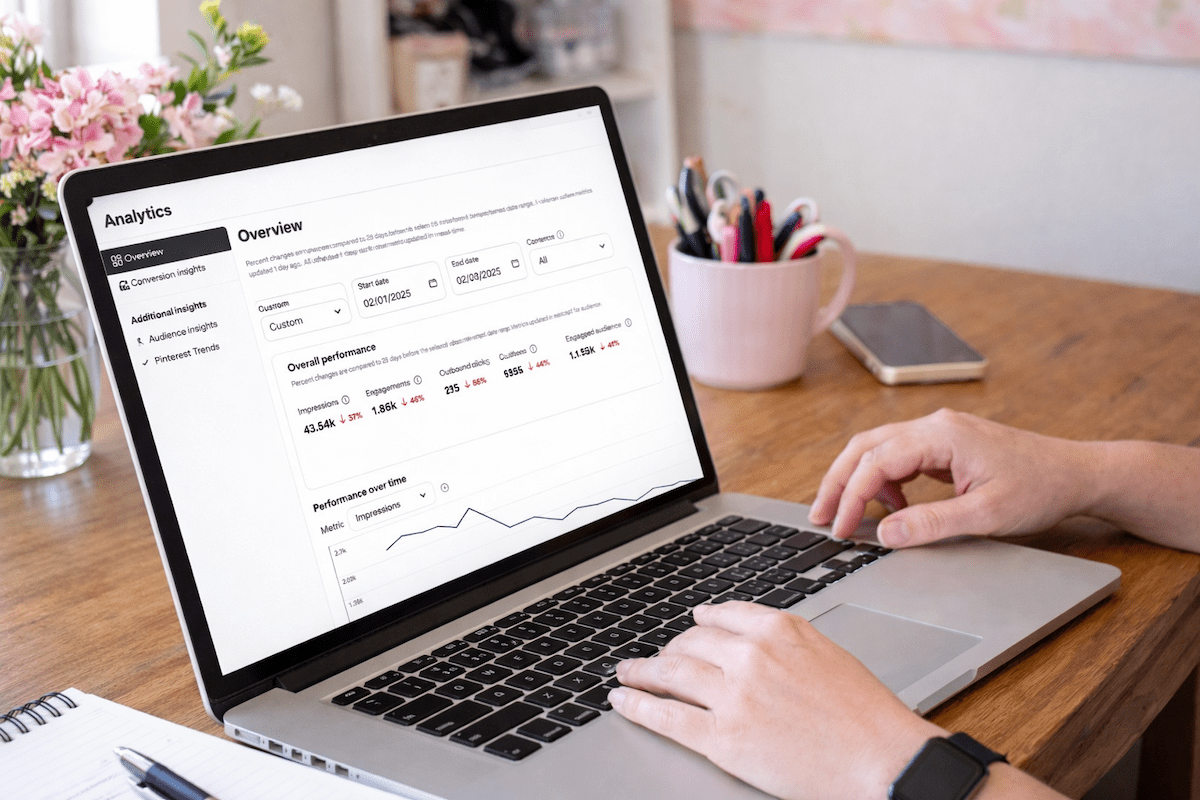
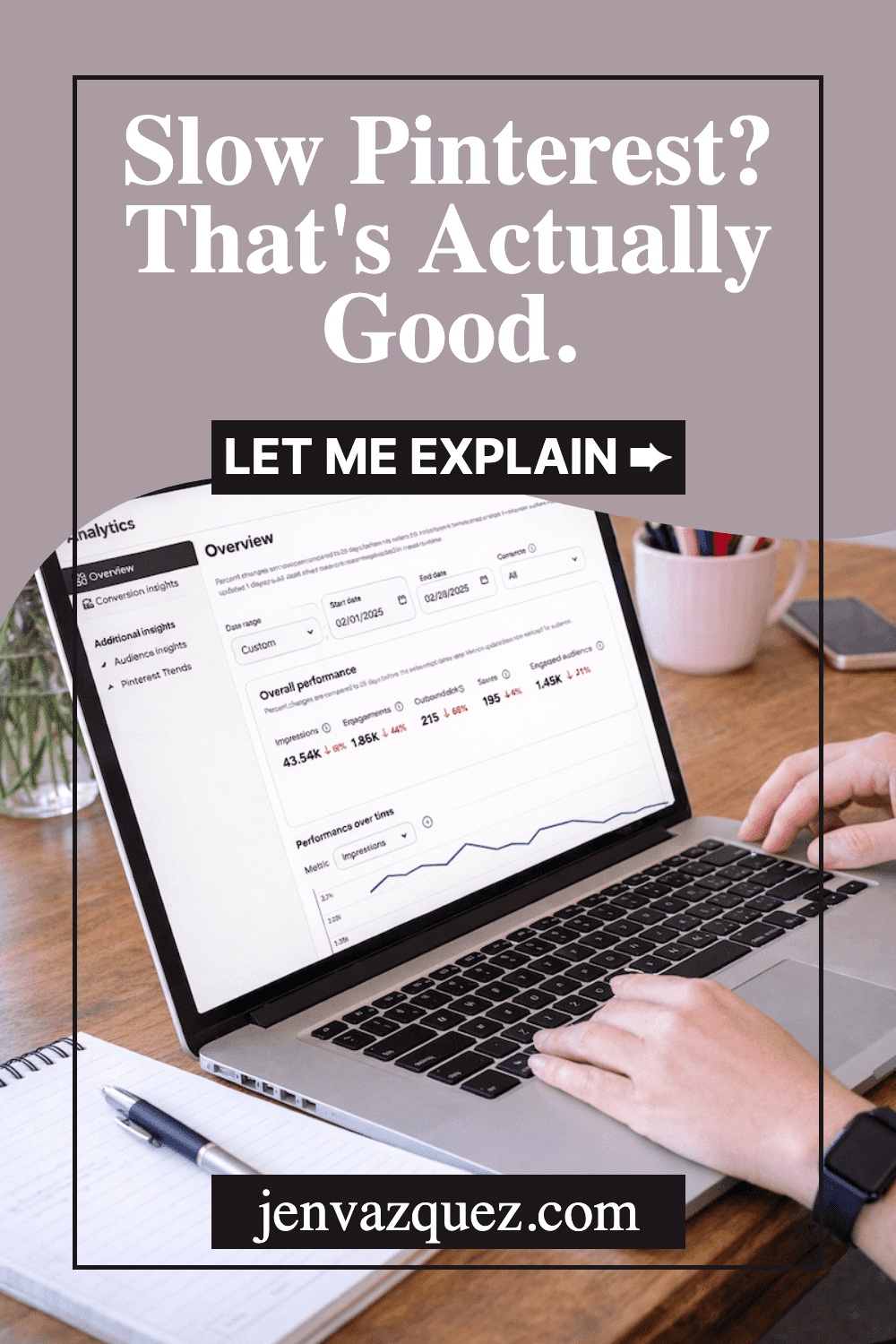
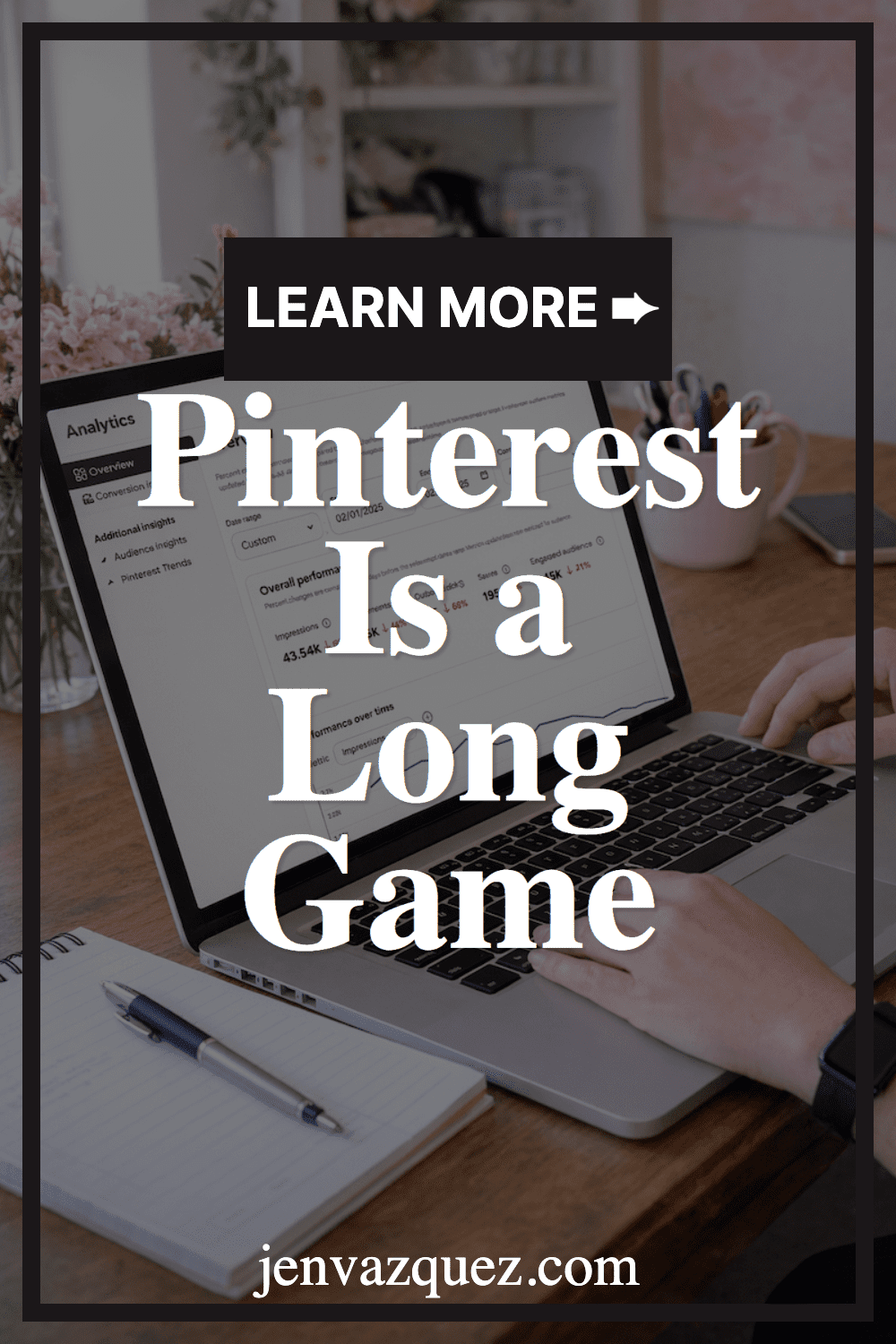
Pinterest analytics on a laptop illustrating long-term Pinterest growth and performance trends

Why Pinterest Feels Slow (And Why That’s Actually a Good Sign for Your Business)

If Pinterest feels quiet right now, I want you to hear this loud and clear: that doesn’t mean it’s broken. And it definitely doesn’t mean you’re doing anything wrong.

This is one of the most common moments where people start second-guessing everything. And it’s usually the exact moment they quit Pinterest… right before it starts working.

Hey, I’m Jen Vazquez. I help service providers use Pinterest in a way that actually leads to clients — not

Pinterest Is Not Instant Feedback (And That’s the Point)

Pinterest isn’t social media. I know I say that all the time, but it matters here.

Pinterest is a search marketing platform — just like YouTube. And search takes time.

When you post a pin, Pinterest doesn’t blast it out and judge it in 24 hours. It quietly tests it behind the scenes. It shows it to small groups, watches who saves it, learns what searches it belongs in, and gathers data.

That phase feels invisible. And honestly? That’s where most people get uncomfortable.

Quiet Does Not Mean Broken

Let’s reframe the silence.

Quiet doesn’t mean Pinterest isn’t working.
Quiet usually means Pinterest is learning.

And learning takes time.

This is why so many people quit Pinterest right before it starts working. They assume that if they don’t see fast results, it must not be worth the effort.

But Pinterest isn’t designed for urgency or panic. It’s designed for long-term visibility.

Feeling stuck or confused by your marketing?

My Marketing Coaching Calls are perfect if you want a second set of expert eyes on your strategy. We can look at Pinterest, walk through your analytics, simplify your marketing workflow, and get clear on your overall visibility — together on a private video call. You’ll leave with real clarity and a clear action list for what to do next.

Instagram Rewards Speed. Pinterest Rewards Consistency.

Instagram gives you instant feedback. You post something, and within minutes you know if it hit or flopped. Then 48 to 72 hours later? It’s gone.

Pinterest works differently.

Pinterest is more like a snowball rolling downhill. It starts small. It picks up a little traction. Then a little more. And over time, it turns into something that keeps working without you having to push every single day.

If you’re showing up consistently, talking about clear topics, and sending people somewhere helpful, you are building something — even if it feels slow right now.

Why Stopping Early Is the Real Mistake

The biggest mistake I see isn’t bad pins or wrong keywords.

It’s stopping too soon.

People assume silence means failure. So they quit. And they never get to the part where Pinterest actually starts compounding.

Pinterest is a long game. But it’s one that keeps paying you back — with traffic, leads, and visibility that doesn’t disappear overnight.

Build for the Long Term (Not the Spike)

If you want to understand how long-term visibility really works — not just on Pinterest, but across your entire marketing — I’d love to invite you to the Creative Marketing Summit 2026.

It’s our fourth year, Tailwind is sponsoring again for the fourth year in a row, and it’s a free online event built to help your marketing actually lead somewhere. Not just look busy.

You can grab your free ticket at creativemarketingsummit.com.

And if Pinterest feels slow right now? Stay consistent. Stay the course. Or reach out if you want help building a system that fits your real life.

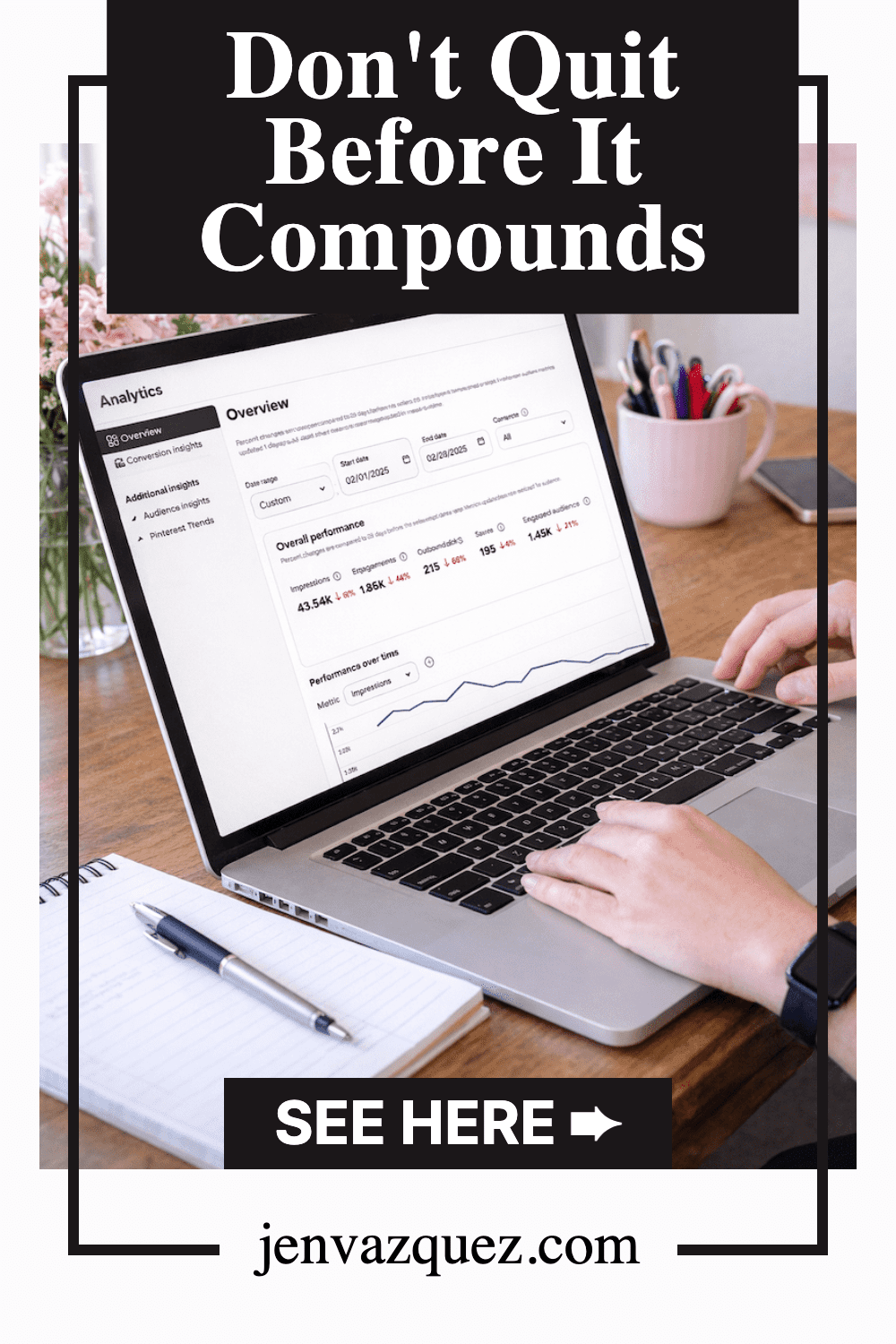
fingers on a laptop keyboard with pinterest analytics on the screen | Why Pinterest Feels Slow (And Why That's Actually a Good Sign for Your Business) by Jen Vazquez Media