Try Jeff Bezos’ 1-Hour Morning Rule with Us: The 30-Day Clarity Challenge

women in bed with white bedding reading a book jvm stock image

Try Jeff Bezos’ 1-Hour Morning Rule with Us: The 30-Day Clarity Challenge

If you’re an ambitious female founder who wants to work smarter (not harder), you’re in the right place. Today I’m sharing the simple, science-backed morning shift I’m testing for 30 days: one screen-free hour right after waking. 

I’m doing it with my co-host, Cinthia Pacheco of Digital Bloom IQ, and I built a Morning Clarity Tracker so we can actually measure how it impacts focus, mood, creativity, and productivity.  We have a free tracker at the bottom!

Why the morning matters (and why I’m changing mine)

Mornings have a special energy. When I roll over and start scrolling news, my day is basically cooked. I’ve been craving more clarity, creativity, and protected time to set the tone before I dive into client work and content. So I’m trying the “one-hour rule”: at the bare minimum, no phone/screens for the first hour after waking.

The one-hour rule (the simple version)

No email, no social, no TV, no news apps—no passive scrolling. Emergencies only if needed. You can still use your device to press play on music or an audiobook without falling into a feed. The goal is zero screen-to-face time so your brain can boot up without cortisol spikes.

Replacement activities menu (pick 1–3)

Instead of scrolling, try:

  • Move your body: light stretching, yoga, a walk outside, or a quick dance session.
  • Nourishing breakfast and real conversation (phones away).
  • Read or listen to a book—educational, inspirational, or purely joyful.
  • Gratitude or brain-dump journaling (3–5 things you’re grateful for + any ideas rushing in).
  • Music to set the vibe.
  • Meditation or breathwork (start with 5–10 minutes; box breathing works wonders).

Plan your 1–3 activities the night before so you don’t replace scrolling with decision fatigue.

How I’m tracking it (because data > vibes)

I created a Morning Clarity Tracker (super easy drop-downs) to log:

  • Wake-up time
  • Activities you chose
  • How you felt (calm, restless, energized, etc.)
  • Any slip-ups (no shame, just notes)
  • Quick reflections

We’ll compare our weekly notes to phone Screen Time or Digital Wellbeing stats so we can see the impact, not just guess.

Weekly check-ins (adjust without judgment)

At the end of each week, ask:

  • Did avoiding screens help my clarity, mood, and energy?
  • Was I more productive?
  • What activities lit me up—and which can I skip?
  • Do my Screen Time screenshots show progress?

Tweak as needed. If an hour spikes your stress, try 30 minutes and build from there.

End-of-month reflection (make it real)

After 30 days, review:

  • Focus, creativity, productivity, and mental health
  • Whether you actually stuck with it (and why)
  • If you’ll keep going—and how to adapt it to your real life

If it “worked” but you still resist it, journal on what’s underneath that. Sometimes the mindset shift is the real work.

Day 1: honest results from both of us

I set up my phone the night before with only Audible open so I could tap play eyes-closed. Full transparency: I felt anxious at first—like I was “wasting” my early work time. Around the 38-minute mark, the anxiety dropped and the rest of the hour felt amazing. Cinthia journaled, ate without multitasking (progress!), and felt noticeably calmer. We’re calling that a win.

Guardrails that help (because…phones are sticky)

  • Phone Screen Time schedules (or apps like Opal) to block socials late at night and early AM
  • Zero notifications except true emergencies
  • A playlist you can start hands-free
  • Accountability—do this with a friend (hi, Voxer buddies)

Try it with us

Pick your 1–3 activities, print or copy the tracker, and give yourself grace. If you slip, note it and keep going. We’ll share a mid-month check-in and a 30-day results episode so you can compare notes with us. 

If you found this helpful, share it with a fellow founder who could use a calmer, clearer morning.

UPDATE: What Happened After 30 Days (Our Honest Results)

If you’ve been wondering, “Okay, but did this actually work for you two?” — here’s the real talk.

Cinthia and I did the Morning Clarity Challenge for all of October. That meant:
No phone, no email, no social, no news, and no work for the first hour of the day. Just the Morning Clarity Tracker, simple habits, and a lot of curiosity.

What changed for us

Here’s what we noticed over the month:

  • The phone habit broke faster than we expected: The first few days felt weird. We both had that “reach for my phone” reflex. But after about 5 days, it was already easier to leave the phone on the nightstand and just start the day.
  • Mornings felt calmer (and our families felt it too): Cinthia found she was way more present with her daughter during breakfast instead of half-listening while scrolling. My husband even said, “Mornings feel easier now. You seem more relaxed.” That was a big sign this was working.
  • We stopped starting the day in panic mode: Before, I would wake up and go straight into email or news — which often meant stress before I even got out of bed. Now, I check urgent things the night before, and my mornings feel like my time again.
  • It became a habit, not a fight: By the middle of the month, we weren’t forcing it. It was just “how we do mornings now.” I even stretched that first hour into two on slower days so I could listen to a book and ease into work.
  • We only “broke” it once: There was one day in October where I slipped and started the day with client messages and email. Guess what? My whole day felt off. That one day was enough proof that the new way was better.

How the tracker helped

The Morning Clarity Tracker wasn’t just a cute extra — it helped us see patterns:

  • Which activities made us feel calm, happy, or focused
  • Which ones we could skip
  • How our mood and energy lined up with less screen time
  • How often we actually stuck to the one-hour rule

When we looked back at notes and phone Screen Time, the data matched how we felt:
Less morning scrolling = more calm, better focus, and nicer mornings for everyone around us.

What We’re Trying Next: 1 Screen-Free Hour at Night

We loved the morning change so much that we’re now testing a night-time version in November.

The goal: One hour at night with no TV, no doom scroll, no social apps — just rest, real life, and winding down.

Here’s what that looks like for us:

  • Pick a “screens off” time: We’re starting with something simple like 10:00 PM. For you, it might be 9:30 PM or even 11:00 PM if you’re usually up late. You can always move it earlier later.
  • Make it a house rule (with some flex): For me and my husband, that looks like:

    • TV off at a set time
    • Phones down unless it’s a true emergency
    • Weekend “free nights” where we can watch a show or play games without rules

  • Swap in real rest, not more noise: Some ideas we’re trying:

    • Reading or listening to a book with phones set aside
    • Talking with our partners instead of zoning out side-by-side on screens
    • Light planning for the next day so mornings feel smoother
    • Simple, quiet hobbies that help our brain slow down

  • Use tools to help your future self: Cinthia uses an app called Opal to block Instagram, WhatsApp, and other time-suck apps after a certain hour. You can also use built-in Screen Time limits on your phone to do the same thing.

The point isn’t to be perfect.
The point is to give your brain and body a real “off” ramp at the end of the day so you’re not going to sleep wired and waking up tired.

Want to Join Us for the Evening Screen-Free Hour?

If you loved the idea of the Morning Clarity Challenge, this is the next step:

  1. Pick your evening “screens off” time for the next 30 days.
  2. Choose 2–3 simple replacement habits (read, talk, stretch, journal, or just rest).
  3. Use the same Morning Clarity Tracker or a fresh page to jot down:

    • What time you turned screens off
    • What you did instead
    • How you felt that night and the next morning

We’ll be checking back in on the podcast with our results, what worked, what didn’t, and how this ties into working smarter as female founders — not burning out on our phones.

👉 Scroll up, grab the tracker from Episode 40, and try the morning and/or evening challenge with us. 

Small shifts like this can quietly change how your whole day feels. 💛

📌 DON’T FORGET TO PIN IT!
Try Jeff Bezos’ 1-Hour Morning Rule with Us: The 30-Day Clarity Challeng

Why SEO + AI Content Matters for Female Founders in 2025

Why SEO + AI Content Matters for Female Founders in 2025 on Marketing Duo Podcast with Jen Vazquez and Cinthia Pacheco<br />

35 | Why SEO + AI Content Matters for Female Founders in 2025

Hey there! Welcome back to the Marketing Duo Podcast—where Cynthia from Digital Bloom IQ and I (Jen from Jen Vazquez Media) come together to share all the good stuff that helps female founders like you scale smarter, not harder.

This episode dives into a topic that’s evolving quickly: how AI is changing the way we approach SEO and content. If you’ve been stressing about keywords or wondering how AI search will affect your business visibility—this one’s for you.

SEO Isn’t Just About Keywords Anymore

Once upon a time, SEO advice was all about stuffing your content with keywords. Remember when the golden rule was “two to three words repeated everywhere”? Well, those days are behind us. Search engines—and AI models—are smarter now.

Instead of fixating on exact phrases, it’s about writing in a way that answers your audience’s questions clearly and naturally. Think about the intent behind the search, not just the literal words.

Why Intent is Everything

Intent is the new SEO power move. Rather than asking, “Did I use the right keyword enough times?” ask, “Does this piece of content actually give value to my ideal client?”

Google (and AI!) want to serve up content that’s helpful, not robotic. That means your blogs, podcasts, and videos should be framed around the problem your dream client is trying to solve.

Introducing the Search + AI Foundation Setup

Cynthia and her team at Digital Bloom IQ have created something really exciting—a Search + AI Foundation Setup. It’s a hands-on service where they go into your site and set up the foundational SEO and AI visibility you need to start ranking.

The best part? It’s low-cost, high-impact, and completely hands-off. They do the heavy lifting while you stay focused on running your business. It’s designed for solo entrepreneurs and small businesses who don’t have the bandwidth to manage SEO themselves but want results that bring in more clients.

Why This Matters for Female Service Providers

If you’re a service provider, you already know how important it is to get found online. Your dream clients are searching right now—and the way search is shifting means you want to be ready. AI-powered search will prioritize content that’s valuable, authentic, and set up with strong foundations.

So whether you’re brand new in business, pivoting services, or simply too busy to fuss with SEO, this is the perfect way to get your digital house in order before the busy season hits.

DON’T FORGET TO PIN IT!
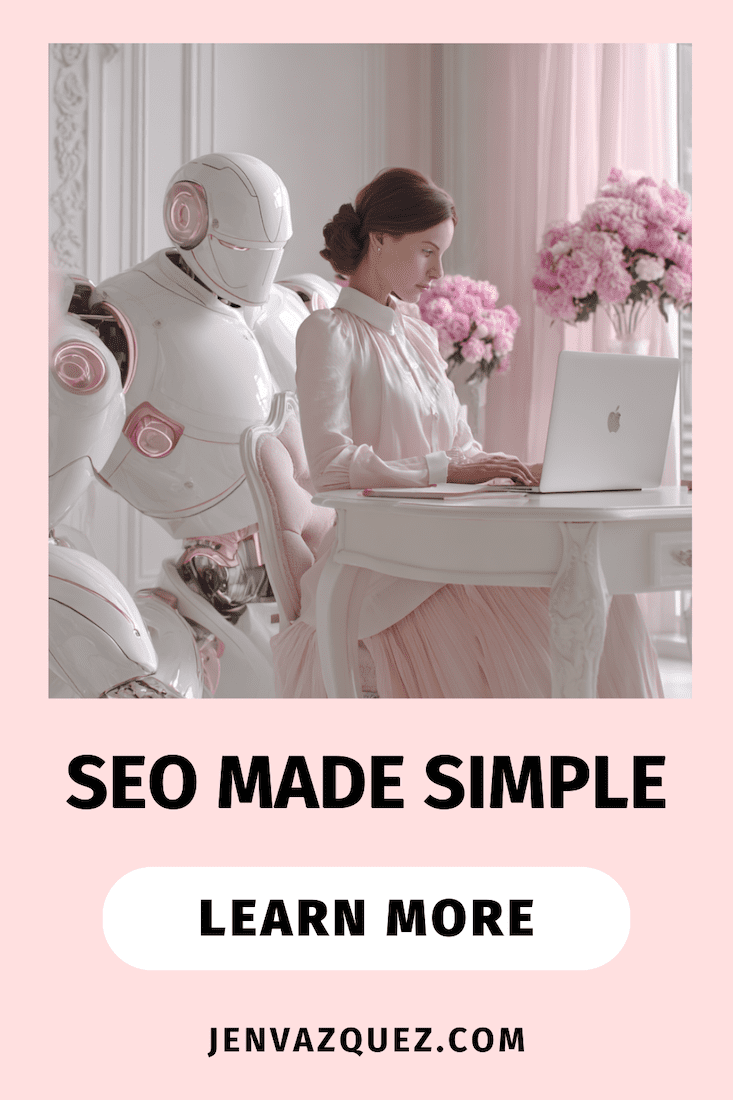
Why SEO + AI Content Matters for Female Founders in 2025 on Marketing Duo Podcast with Jen Vazquez and Cinthia Pacheco
Why SEO + AI Content Matters for Female Founders in 2025 on Marketing Duo Podcast with Jen Vazquez and Cinthia Pacheco<br />

Do You Really Need to Be an Influencer to Grow Your Business?

Do You Have to Be an Influencer to Succeed?

If you’ve ever wondered, “Do I need to be an influencer to grow my business?” — you’re not alone. We hear this question all the time from service providers and business owners just starting out. It’s a big one. And the short answer? Nope, you don’t. But let’s break it down.

Why Video Still Matters (Even If You’re Camera-Shy)

In today’s marketing world, video is key. That doesn’t mean you need to be dancing on Reels or going viral every week. But people want to see real humans doing real things. That could be you—or someone else showing your product or service. Even faceless videos with voiceovers can build connection and trust.

The truth is, video gives your audience context. A clip of your product in use or someone sharing how your service helped them? That goes way further than just a static image.

What If I Hate Being on Camera?

We get it. Not everyone wants to be the face of their brand. And that’s okay! You can still create content that connects. Here are a few ways:

  • Use a voiceover with B-roll footage (your hands, your desk, your product)
  • Ask a friend or happy client to create a video for you (hello, UGC!)
  • Do a camera-facing video using a teleprompter app like BigVu—it makes things way easier

Just like learning to drive to a new place, showing up online feels awkward at first. But it gets easier the more you do it. You don’t need to post every day—you just need to start.

Pick the Type of Marketing That Lights You Up

If Instagram makes you cringe, try podcasting. If writing’s your jam, lean into blogging. You get to choose. Your only job is to make sure people can find you, and feel connected when they do.

And don’t forget: you can reuse content. One blog post can become a week’s worth of Reels. One client video can be repurposed across your site, email, and Pinterest. Content is a tool—use it in a way that works for you.

You’re Not a Full-Time Creator—You’re a Business Owner

At the end of the day, you’re not trying to go viral—you’re trying to get leads and grow your business. Influencer-style marketing isn’t required. But creating helpful, relatable, or inspiring content? That’s non-negotiable.

If your goal is connection, sales, and growth… then yes, you need content. But no, you don’t need to be an influencer.

DON’T FORGET TO PIN IT!
28 Do You Really Need to Be an Influencer to Grow Your Business on Marketing Duo Podcast
two cell phones one with instagram and one with tiktok 28 Do You Really Need to Be an Influencer to Grow Your Business on Marketing Duo Podcast
28 Do You Really Need to Be an Influencer to Grow Your Business on Marketing Duo Podcast
two cell phones one with tiktok and one with instagram 28 Do You Really Need to Be an Influencer to Grow Your Business on Marketing Duo Podcast
women holding up two fingers in a peace sign holding a cell phone up to her eye 28 Do You Really Need to Be an Influencer to Grow Your Business on Marketing Duo Podcast

How AI and Vibe Marketing Are Changing the Future of Business

How AI and Vibe Marketing Are Changing the Future of Business on Marketing Duo Podcast with Jen Vazquez and Cinthia Pacheco

How AI and Vibe Marketing Are Changing the Future of Business

In this episode of the Marketing Duo Podcast, Jen Vazquez of Jen Vazquez Media and Cinthia Pacheco of Digital Bloom IQ explore how artificial intelligence and the rise of vibe marketing are reshaping the way small business owners market and sell their services. From real-time coding with AI to Amazon’s new Buy for Me feature, they unpack it all in their signature chill and curiosity-driven style.

What is Vibe Marketing?

Vibe Marketing is the idea of using AI tools in a conversational way to build and execute marketing strategies. Instead of the old-school approach of planning, drafting, and editing solo, you literally talk to your AI assistant—like ChatGPT—and get ideas, feedback, content, pricing help, and more. Think of it like having a marketing bestie that’s always available to brainstorm and build with you.

This term was recently shared by Christopher S. Penn, an expert in data-driven marketing and analytics. He describes vibe marketing as the fusion of AI-powered tools and natural conversations to help entrepreneurs take faster, more intuitive action.

Examples of Vibe Marketing in Action

  • Cinthia used ChatGPT’s voice feature while sitting in traffic to map out an entire launch, from pricing to emails, just by talking through it.

  • AI-powered coding tools like Windsurf and Lovable help generate websites and apps in minutes, speeding up development time.

  • Jen uses AI for role-playing difficult conversations and double-checking strategy, making her feel more confident and supported in her business decisions.

Cinthia also used AI to create an entire product and launch plan called Found in AI: The Visibility Bundle while driving—yes, literally talking it out with ChatGPT using the voice function.

What This Means for Service-Based Businesses

AI is making it easier (and faster) to get high-quality work done. But instead of replacing your expertise, it acts more like a collaborator. You still bring the strategy, the experience, and the personal touch—AI just helps you get there faster.

Amazon’s “Buy for Me” Feature

One of the biggest AI updates is from Amazon. Their new “Buy for Me” beta helps users search not only on Amazon but across other brand websites too. It makes Amazon more of a shopping hub and highlights how major companies are focusing on helpful, user-first AI tools.

Read more about this feature directly on the Amazon Blog.

Will AI Replace Designers, Photographers, or Marketers?

Not likely—at least not fully. While tools like MidJourney and ChatGPT can create impressive images and content, people still want real connection and customized service.

Jen explains how her brand photography clients value the experience and personal storytelling behind each photo shoot, something AI can’t yet replicate.

Cinthia notes that even as tools get smarter, small business owners still crave support from real humans who get their vision.

AI as a Business Partner

The more you use AI tools, the better they get at helping you. Whether you’re writing emails, launching a new offer, or mapping out your next quarter’s goals, AI can:

  • Help you brainstorm and write faster
  • Offer suggestions you might not think of
  • Coach you through mindset blocks
  • Save you hours of time

As Cinthia says, “It’s a shortcut for revenue-generating tasks.”

Final Thoughts

Whether you’re dipping your toes into AI or diving in headfirst, the goal is to use these tools in a way that supports your creativity and your goals. Test things out. Stay curious. And most importantly—keep showing up.

Want to be part of the conversation? Find us on Instagram @MarketingDuoPodcast and let us know how you’re using AI in your business.

Don’t Forget To Pin It!

How Amazon’s Buy for Me Works on Marketing Duo Podcast with Jen Vazquez and Cinthia Pacheco
Using AI to Boost Your Business on Marketing Duo Podcast with Cinthia Pacheco and Jen Vazquez
What is Vibe Marketing_ on Marketing Duo Podcast with Jen Vazquez and Cinthia Pacheco
AI for Small Business_ Real Examples on Marekting Duo Podcast with Jen Vazquez and Cinthia Pacheco
How AI is Changing Marketing in 2025 on Marketing Strategy Academy

AI vs SEO: Why Your Website Still Matters in the Age of Artificial Intelligence

 AI vs SEO: Why Your Website Still Matters in the Age of Artificial Intelligence

Cynthia and Jen always bring their energetic, giggly charm to the Marketing Duo podcast—and in this episode, they tackle a hot-button topic: will AI replace SEO?

Spoiler: No, it won’t.

Instead, this conversation unpacks how AI is reshaping search, why foundational SEO still matters, and how to use tools like ChatGPT without sabotaging your marketing strategy. They even pull back the curtain on how they’re building custom AI systems for their clients. If you’re a business owner wondering whether to invest in your website or let AI do all the work, keep reading.

Why Should I Invest in SEO If AI Is Just Going to Do It All?

This is the question—or more accurately, the assumption—that Cynthia hears constantly. Some folks believe websites will be obsolete soon. Others are convinced no one will use Google anymore, instead turning entirely to AI.

But here’s the reality: people are still searching on Google. And more importantly, Google itself is powered by AI.

AI isn’t replacing SEO. It’s changing how search works—and your SEO strategy needs to evolve along with it.

AI vs Google: Competitors or Coexistors?

It’s easy to think of AI and Google as competing forces. But Google has its own AI—baked right into its search engine. When you Google something like “160 Fahrenheit to Celsius,” you’ll often get an AI-generated answer directly in search results.

Google has years of experience understanding what users want and is integrating AI to stay relevant. If you want your business to show up in AI-powered results—whether in Google or tools like ChatGPT—you still need foundational SEO in place. That includes:

  • A functional, optimized website

  • Consistent blog content

  • Clear keyword strategy

No blog? No website? Then how do you expect to show up in search results—AI or otherwise?

Yes, You Still Need a Website

AI can’t replace the credibility, security, and authority your own website gives you.

Cynthia shares how not having a website can cost you real sales. She’s seen it herself—people find you on social media, love your content, and go to your site for confirmation. If there’s nothing there? Confidence drops. You may lose the sale. Jen echoes this too, adding how her own leads often convert because her site reassures them they’re in good hands.

A website is also a safety net. Social media platforms can change overnight. But your website? That’s digital real estate you own. It’s where SEO lives and where your authority grows over time.

But I Use ChatGPT for My Keywords…

Jen shares that she’s heard many business owners say they use AI tools to pull keywords instead of Google Analytics or proper SEO tools. That’s a red flag.

Why? Because ChatGPT doesn’t access real-time search data. It can’t tell you what people are Googling today. Google Keyword Planner, Google Search Console, and tools like Ahrefs or SEMrush are still essential for gathering current SEO data.

Cynthia explains how they use ChatGPT as a polishing tool—to help reword content or test a hypothesis, but never as the sole source of truth.

What Happens If You Rely on AI Alone for SEO?

Using AI without verification can hurt you. Literally. Google may penalize your site if your content is unhelpful or misleading. Remember: Google knows when something is AI-generated.

And most AI content isn’t naturally helpful. It’s generic. Overwritten. Filled with fluff or inaccurate info.

AI is great at creating a draft. But it’s up to you to:

  • Verify facts

  • Customize to your voice

  • Include accurate SEO practices

  • Ensure it’s genuinely helpful to your audience

Jen offers a golden tip: aim to write using the top 500 most-used English words. This improves clarity, keeps your tone natural, and ensures your content is accessible.

The Real Value of AI: Support, Not Replacement

Both Cynthia and Jen agree—AI is a brilliant support tool. Cynthia uses it to generate custom AI assistants for clients, trained specifically on their brand voice and needs. That’s way beyond using basic ChatGPT.

They’re building out proprietary tools that go deeper than generic AI outputs, making the process faster and smarter, not automated in a lazy way.

Cynthia also recently gave a talk on this very topic inside Jen’s Facebook Group (which she highly recommends you join). She dives even deeper into how AI is shifting marketing and how to prepare your content strategy.

Foundations Still Matter—Maybe More Than Ever

This episode is a wake-up call: stop trying to skip steps. Quick hacks won’t sustain a business. Even if AI creates 50 blog posts for you overnight, if they’re not strategic, helpful, and accurate, they’re not going to perform.

Want to make money while taking time off? Want evergreen leads? Want sales without being online 24/7?

Then you need SEO. You need a site. And yes, you can use AI—but only with systems and standards that ensure quality.

Final Takeaway

AI is evolving fast, but it hasn’t replaced search. And it hasn’t replaced trust. SEO and websites are still critical to building a brand that lasts.

Use AI wisely, strategically, and never skip the basics.

If you want to dive deeper into these strategies, check out Jen’s Facebook Group, where Cynthia is offering exclusive training on how to start showing up inside AI-powered search tools. 

You can also sign up for Cinthia’s masterclass on the AIO.

Or DM the Marketing Duo on Instagram if you’d love to see AI-customized services in the future!

Don’t Forget To Pin It!!