How to Build a Pinterest Strategy from Scratch If You’re a Service Provider
Because Almost All Pinterest Advice Is Built for Bloggers
If you’ve been putting off Pinterest because you don’t know where to start, you’re not alone. And honestly? The confusion makes sense. Almost all Pinterest advice out there is built for blogging businesses or product businesses, and it does not translate the same way when you’re selling a service.
So let’s fix that.
Pinterest is what I’ve built my business on since 2009. It’s how I grew my photography business to six figures, and it’s the reason Jen Vazquez Media even exists. I’m also a Pinterest Pioneer, which means Pinterest actually tapped me to help educate in their business community. So when I say this platform works, I am not guessing.
Let’s build your strategy.
First: Understand What Pinterest Actually Is
This is the single most important thing to understand before building anything.
Pinterest is not social media. It’s a search marketing platform.
I know that sounds like a weird thing to say, but this distinction changes everything about how you use it. Pinterest is a visual search engine. People don’t go there to scroll and see what you had for breakfast. They go there to search, to find solutions, and to discover things they’re already looking for.
That means your content doesn’t disappear in 24 hours, as it does on Instagram or TikTok. It gets indexed. It gets found over and over again, just like Google with your blogs or YouTube with your videos. Sometimes for months. Sometimes for years.
That is an extreme power that Pinterest has that none of the social media platforms actually have. And that’s why the strategy we’re building here looks completely different from anything social media teaches you.
Step 1: Clarify Your Message
Before you pin a single thing, you need to be clear on three things:
- Who you actually serve. Get specific. If you’re trying to speak to everyone, you end up speaking to no one.
- What problem do you solve? Not your job title, but the actual problem your client has that you can fix.
- What outcome are they wanting? What does life look like after they work with you?
For me, it’s female service providers who want more leads and more traffic to their content. For my photography side, it’s female entrepreneurs in the Bay Area. Those are specific audiences with specific needs.
Pinterest rewards clarity. If your message is vague or confusing, your content can’t compound. It has nowhere to go.
Step 2: Optimize Your Pinterest Profile for Search
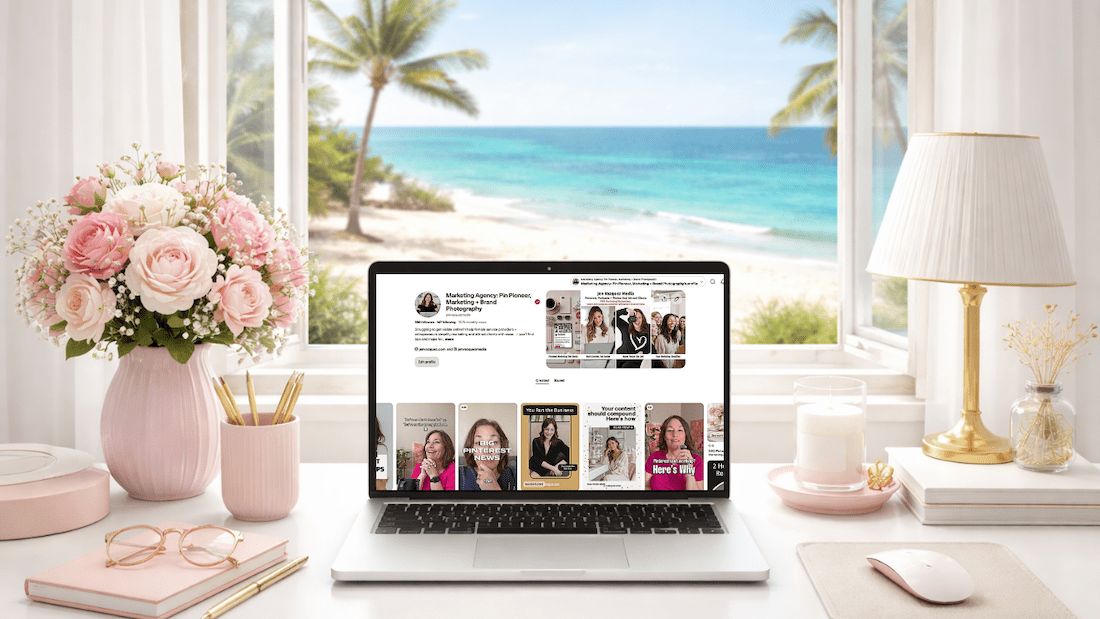
Your Pinterest profile is searchable from day one. Every word matters.
Your Display Name
Include your name plus a keyword or two about what you do. Something like: Jen | Pinterest Marketing for Service Providers. (Quick note: Pinterest doesn’t let you use the word “Pinterest” in your display name, so I use “Pin Marketing.” You gotta do what you gotta do to get found.)
Your Bio
Write your bio like a search result. What do you do? Who do you help? What will they get from following you? Use the exact words your ideal client would type into a search bar.
Pro tip: Ask your clients what they’d actually type in to find someone like you. You can also use an Instagram story with a question box to crowdsource this.
Your Link
Send people somewhere with a very clear next step. A freebie, a service page, or a landing page in the description of your Pinterest profile. Traffic without direction is just noise.
Want help with Pinterest?
If you want ongoing help while you build this out, The Club is a membership where I drop new Pinterest trainings every single month, plus live Q+As and the strategy and accountability to keep you moving forward at an affordable price, month to month.
Step 3: Build Keyword-Rich Boards
Your boards are searchable. Name them the way your ideal client would type into that search bar, not the way you’d organize a personal Pinterest account.
Skip cute board names like “My Faves” or “Inspo.” Instead, use something like:
- Pinterest Marketing Tips for Service Providers
- Brand Photography Ideas for Female Entrepreneurs
- Marketing Strategies for Coaches
Every board also has a description field. Pinterest doesn’t force you to fill it in, but you absolutely should. Go back into each board, click the three dots, edit it, and write at least two to three sentences. Think about all the different things you’ll pin to that board and weave those keywords into the description.
Aim for 8 to 12 boards that are clearly relevant to your business. Not 40 random boards with a scattered focus. And if there’s a service you want to do more of, create two boards around that topic.
One more tip: every Pinterest account should have a board with your business name. Mine is “Jen Vazquez Media.” Everything I pin goes there. It helps people who search for your business name on Pinterest actually find your content and your account.
Step 4: Create Content That Answers Real Searches
Here’s the mindset shift that makes Pinterest finally click.
Stop thinking about what you want to share. Start thinking about what your ideal client is actually searching for.
Ask yourself: What does my ideal client type into Pinterest when they need what I offer?
Some examples:
- Brand photographer: “What to wear to a brand photo session?”
- Business coach: “How to get more clients as a coach online.”
- Pinterest strategist: “How to use Pinterest to grow my service business.”
Your pin titles, pin descriptions, and the content you link to should all be answering those real searches. Not what sounds good to you, but what people are actually typing into the search bar.
And here’s something that surprised me: for brand photographers, the bigger search isn’t “brand photographer [city].” It’s “[city] brand photography.” The order matters. So you really want to know what your clients are searching for. Ask them. Put the question in your weekly email. Use Instagram stories. That’s the sweet spot of everything on Pinterest.
Step 5: Pin Consistently, Not Constantly
You do not need to pin 30 times a day. That advice is outdated and honestly exhausting.
For service providers, what Pinterest rewards is consistent quality content that earns engagement over time. Start with 5 to 10 pins per week. I always recommend a minimum of one pin per day.
The majority of your pins should link to your own content. It used to be years ago, the recommendation was 80% other people’s content and 20% yours. That is long gone. The only exception is if you partner with someone on something or if you value someone’s education that you don’t teach yourself.
Your pins will mostly be linking to blog posts, videos, podcast episodes, service pages, and your lead magnet. That lead magnet piece is the best way to grow your email list through Pinterest.
Consistency over time is what builds compounding traffic. Not volume.
Step 6: Connect Pinterest to Your Larger System
Pinterest is a traffic driver. It sends people somewhere. So the question is: where?
The strongest Pinterest strategies connect to a very clear path:
- Pin to a blog post, which leads to an email sign-up for your freebie
- Pin to a service page
- Pin directly to a discovery call booking page
Every single pin should have a bigger purpose. Traffic without direction is just noise, and you will not convert people without a clear next step.
Common Mistakes to Avoid
- Pinning mostly other people’s content. This builds their audience, not yours.
- Skipping keyword research. Keywords are not optional. If Pinterest doesn’t know what your content is about, it cannot surface it in search. Period.
- Quitting in month two or even month six. Pinterest is a slow start but a strong finish platform. Most people stop right before the compounding kicks in. Don’t be that person.
- Treating Pinterest like Instagram. Trending audio, daily posting pressure, chasing the algorithm. None of that applies. This is a search engine. Approach it like one.
- Following outdated advice. If any Pinterest content, even mine, is more than six months old, it could be outdated. Be thoughtful about that.
What’s a Realistic Timeline?
I always want to give you an honest average answer on this, but full disclosure, it can change depending on your business goals and your industry.
- Months 1 and 2: Typically quiet. Pinterest is indexing your content. This is normal and does not mean it’s broken.
- Months 3 and 4: Impressions start rising.
- Months 5 and 6: Link clicks start moving in.
- Beyond that: Compounding traffic. Old pins resurfacing. Content you built months ago keeps driving results.
That timeline is exactly why consistency matters more than anything else on this platform. Pinterest isn’t about going viral. It’s about showing up in the right searches until traffic compounds.
What to Learn Next
Now that your strategy foundation is in place, the single most important tactical skill you need next is knowing how to find and use keywords. Because without the right keywords, none of this works. Your content exists, but nobody finds it. That’s exactly what we’ll be covering next week.
Ready to Build Your Pinterest + SEO Visibility System?
How much time did you spend on social media this week creating content? And how many of those posts are still working for you right now, still driving traffic today?
That’s the thing about social media. You create it, it disappears, and you start over every single week.
The Quiet Growth Accelerator is a 12-week program I created with my friend and SEO expert Cinthia Pacheco. Together, we help service providers build a Pinterest + SEO visibility system that actually compounds over time. Your content keeps getting found. Your dream clients keep showing up. And you’re not chained to the posting hamster wheel to make it happen.
We’re talking done-for-you audits, a custom keyword list built for your niche, a simple two-hour-a-week system, and one-on-one support from both Cinthia and me for the entire 12 weeks.
>> CHECK OUT THE QUIET GROWTH ACCELERATOR <<
Go introduce yourself on Pinterest, Instagram, or TikTok. I’ll be cheering you on from over here! 📣