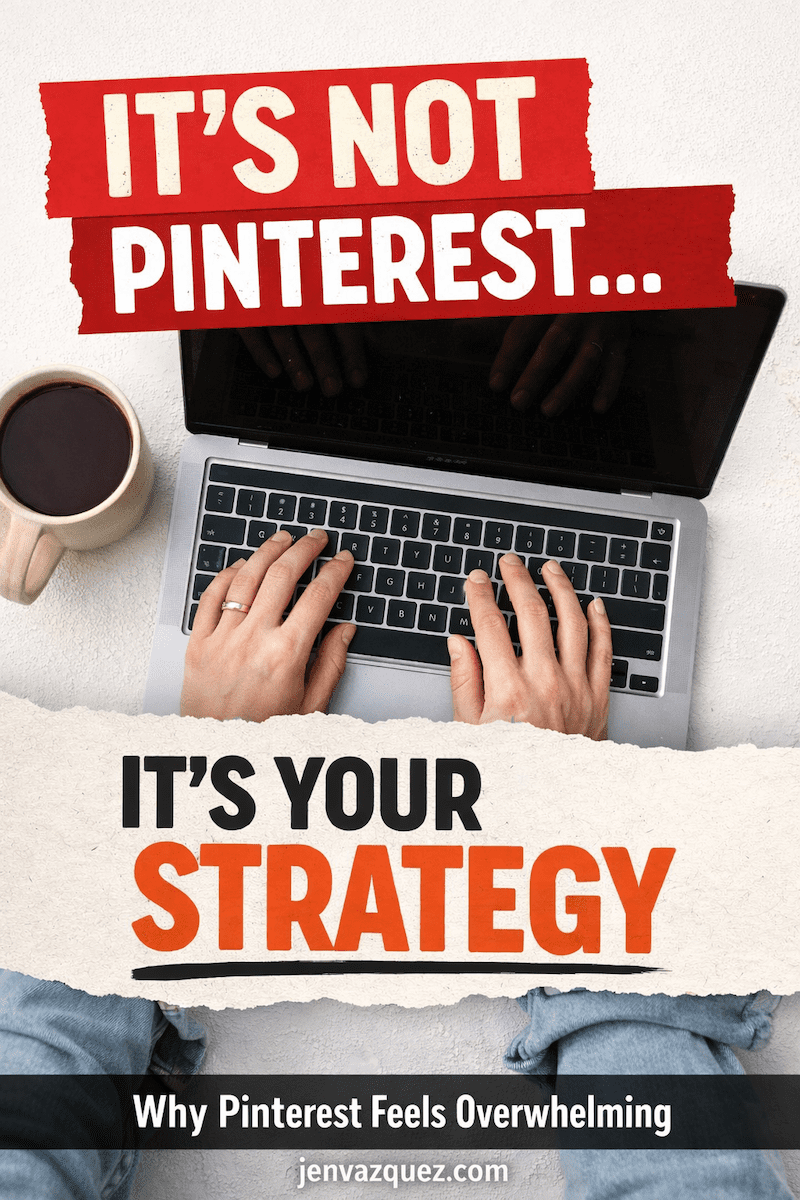
Why Pinterest Courses Don’t Work for Service-Based Business Owners

Why Pinterest Courses Don’t Work for Service-Based Business Owners

And What Actually Gets Results

If you’ve taken a Pinterest course and still aren’t seeing traffic or clients from Pinterest, you’re not alone. And the problem probably isn’t you.

Most Pinterest courses don’t actually work the way people expect them to. Not because the strategies inside them are wrong. But because Pinterest success requires something that courses just really can’t provide.

After working with service-based business owners since 2018, I kept seeing the same pattern over and over. People would take Pinterest courses from really well-known educators, learn the strategy, understand the basics — but when it came time to actually implement that strategy in their own business? Things would stall.

Let’s talk about why that happens.

The Real Problem with Pinterest Courses

There are a lot of really smart educators teaching Pinterest. And many Pinterest courses contain great information. I’m not knocking other educators at all.

But the issue isn’t the information. It’s not the strategy. It’s what happens after the course ends.

Most Pinterest courses follow a pretty similar structure. You learn keyword strategies, pin design, scheduling strategies, and content planning. You go through the lessons, take in the information, feel excited about the possibilities. Then you sit down to apply it to your own business — and that’s when the questions start:

  • Am I using the right keywords?
  • Am I finding the keywords the right way?
  • How many pins should I be posting? (This varies wildly — anywhere from 1 to 20 pins a day depending on your business and industry.)
  • Why isn’t my traffic growing yet?
  • Is Pinterest supposed to take this long?
  • Should I change my strategy?

Most courses can’t answer those questions. Not because they’re bad courses — but because every business is different, and courses rarely provide personalized feedback. 

Sure, some have a community where you can ask a question. But it’s really hard to answer a specific Pinterest question about your business without knowing everything about your business and your ideal client.

A Real Example: Why a Pinterest Course Didn’t Work for My Client

Let me share a story from one of my clients. We’ll call her Lisa.

Before working with me, Lisa had purchased a very well-known Pinterest course. She went through the entire program — not once, but twice — because she thought she missed something the first time. She followed the strategy exactly as it was taught.

And it still wasn’t working for her.

This wasn’t because the course was bad. The problem was that she had no way to get feedback specific to her business.

Most Pinterest Courses Are Built for Bloggers

When we started digging into Lisa’s strategy, something became really clear. The course she’d taken was heavily built around a blogging business model. That works great if you are a blogger focused on ad revenue or affiliate traffic.

But Lisa was a service-based business owner. Her goal wasn’t just traffic — it was booking clients.

Most Pinterest courses advertise themselves as being for everyone or for creatives. But the examples and strategies inside are often designed with bloggers in mind. Service-based business owners operate very differently, and that mismatch can make implementation really confusing.

Ready to See How Pinterest Can Actually Work for You?

I just created a free Pinterest masterclass that walks through the strategy step by step. Inside, I’m going to cover:

  • How Pinterest drives long-term traffic
  • The biggest mistakes business owners make on the platform
  • How to build a strategy that works for you and your business — and actually brings in leads

What Happened When We Changed Her Approach

Once Lisa joined my program, we shifted the focus from learning more information to actually implementing a strategy that worked for her business, her goals, and her life.

She didn’t want to be pinning all week long. She wanted a specific time block, and she could only give about an hour.

The Follow-Up Question That Changes Everything

One of the first things I asked her to do was start asking new clients a deeper question. And this is a mistake almost everyone makes.

When you ask a new client “How did you find me?” and they say something like Instagram or TikTok — that’s not usually the full story.

I started doing this research with my own clients back in 2021. What I found was that about 83% of the time, the quick answer wasn’t the real answer.

When Lisa started asking follow-up questions, the real story came out. Many of these people had actually found her through Pinterest, a Google search, or a blog post. But when people think about where they found you, they usually give credit to the platform they were on when they decided to reach out.

That actually makes sense, right? Someone discovers you on Pinterest, clicks through to your website, reads your content, and then goes and follows you on Instagram. When they finally reach out, they think “I found her on Instagram.”

But Pinterest and search were doing the actual discovery work. They were doing the heavy lifting.

From 5 Hours a Week to 3 Hours a Month

During the seven months Lisa worked with me, we focused on refining her Pinterest strategy. Not starting over. Not guessing. Refining — because she had support and guidance on what to adjust.

She worked on Pinterest three times a month, only an hour each time. Three hours a month total.

We also created a simple marketing workflow that dramatically cut her marketing time. Before working together, she was spending about five hours every week trying to keep up with marketing. Most of that was on social media, and very little on Pinterest — because she had so many unanswered questions.

After we streamlined things, she only needed three hours a month. And with that extra time? She now spends it volunteering at her child’s school.

That’s the kind of result most business owners actually want. Not just traffic — but a marketing system that works without taking over their life.

Pinterest Success Isn’t an Information Problem

This experience reinforced something I’ve believed for years. Pinterest success usually isn’t an information problem — it’s an implementation problem.

Most business owners already have access to more information than they could ever use. You can go to YouTube University, read blogs, take courses, listen to podcasts, even ask AI tools. Information is everywhere.

But execution is where most people struggle. Sometimes they’re just a couple of questions away from getting it right — once they have somebody who actually understands their business and goals.

Pinterest success requires three things:

  • Knowledge
  • Implementation
  • Consistency

Courses usually provide the first one. But the other two are where most people need the most help.

Why I Built My Membership Instead of a Course

This is exactly why I created my Pinterest membership back in 2018. When everyone was telling me to “make a Pinterest course,” I said no.

I wanted to create something different. A space where business owners could actually implement what they learned — with real support.

Inside the membership, we do live trainings, live Q+A sessions, and live masterclasses. When someone gets stuck, they can ask questions and I can even share my screen and show them exactly what I’m talking about. We’re not just typing in a community and hoping we get the right answer.

We address strategy adjustments as your business changes, your goals shift, or your available time changes. And when motivation starts to drop, there’s built-in accountability to keep going.

The goal isn’t just to learn Pinterest. The goal is to actually use Pinterest to bring in clients.

How Pinterest Actually Works (It’s Not Social Media)

If Pinterest has felt confusing, slow, or like it just hasn’t worked the way you expected — it’s usually because Pinterest operates very differently than social media.

Pinterest isn’t about trends the way TikTok or Instagram are. You don’t have to constantly post to stay visible.

Pinterest is about creating searchable content that compounds over time. Think about it — whenever you search for something on Google, Pinterest results come up almost every single time.

That’s the power of the platform. Your content keeps working for you long after you hit publish.

Pinterest courses aren’t necessarily bad. But courses alone typically aren’t enough to create real results. Pinterest isn’t just about learning a strategy — it’s about implementing that strategy consistently until it compounds. That’s the part most business owners need support with.

Ready to See How Pinterest Can Actually Work for You?

I just created a free Pinterest masterclass that walks through the strategy step by step. Inside, I’m going to cover:

  • How Pinterest drives long-term traffic
  • The biggest mistakes business owners make on the platform
  • How to build a strategy that works for you and your business — and actually brings in leads

📌 DON’T FORGET TO PIN IT!

women sitting at desk in feminine home office we're talking about Why Pinterest Courses Don't Work for Service-Based Business Owners

How to Get More YouTube Traffic Using Pinterest

How to Get More YouTube Traffic Using Pinterest by Jen Vazquez on the Marketing Strategy Academy Podcast

How to Get More YouTube Traffic Using Pinterest

Pinterest might not be the first place you think of for YouTube growth, but honestly, it should be. If you want more views without posting every single day, Pinterest is doing some heavy lifting right now—and it’s only getting better.

I’m Jen, and I help service providers build simple marketing systems that work in the background so business doesn’t take over life. Today, I’m breaking down how Pinterest can send steady traffic to your YouTube videos, even if your channel is small.

Pinterest just crossed 600 million monthly users. That’s not a typo. And the best part? People go there to search, not scroll. That means your content doesn’t disappear after 24 hours. It can keep showing up for months—or even years.

Let’s walk through the easy, Pinterest-friendly way to boost your video views.

Why Pinterest Works So Well for YouTube

Pinterest is not social media in the way Instagram or TikTok are. It’s a visual search engine. People open Pinterest with intent. They’re looking for answers, ideas, and how-tos.

When your video shows up in search, it reaches people who already want that topic. That’s why Pinterest traffic tends to be calmer, steadier, and more consistent over time.

If you’re tired of chasing trends or feeling pressure to post constantly, this matters.

Tip One: Skip Direct Sharing from YouTube

Directly sharing a YouTube link to Pinterest usually gives you a small landscape preview. That tiny 16×9 image gets lost fast.

Instead, create a long vertical pin. Think Pinterest first, YouTube second. Vertical pins take up more space, grab attention, and perform better in search.

You’re not changing your video. You’re just packaging it in a way Pinterest understands.

Tip Two: Add a Play Button That Pops

People need to instantly know they’re clicking through to a video. A simple red triangle play button does that job fast.

Place it somewhere visible on the pin. This small visual cue increases clicks because it removes confusion. People know exactly what they’re getting.

If they don’t realize it’s a video and bounce back quickly, Pinterest reads that as low value. Clear signals help your pin perform better.

Tip Three: Use Simple Text Overlay (and Say “Video”)

Don’t just upload a screenshot of your YouTube thumbnail. Keep it clean and clear.

Add short text like:

  • Pinterest Tips (Video)
  • Brand Photos Guide (Video)
  • Client Workflow Tips (Video)

Yes, actually using the word “video” helps. It sets expectations and attracts people who want to watch—not just read.

Clear text gets more clicks. Always.

Make It Even Easier

Want your YouTube videos to bring in steady views without adding more to your weekly to-do list?

My Pinterest management services take care of the whole system — keywords, pin design, weekly posting, and analytics — so your videos keep getting found long after you hit publish.

This is about working smarter, not harder.

Tip Four: Write Descriptions Like a Human

Pinterest is powered by keywords, but that doesn’t mean sounding robotic.

Write descriptions using words people actually type into search:
“This video shows you how to fix your workflow so you can save time and get more leads.”

Short. Real. Helpful. No clickbait.  Pinterest rewards clarity, not tricks.

If you want AI to help, check this out!

Tip Five: Upload Short Video Pins as Previews

Short video pins are perfect previews for your YouTube content.

If you already create Shorts or Reels, you’re ahead. Upload those vertical clips to Pinterest, add text overlay, and include a small CTA like “Watch the full video on YouTube.”

Each new pin gives your content another chance to spike in views. Fresh pins = fresh reach.

Thanks for hanging out with me today. Coming next week, we’re talking all about how to use brand photos to bring in more clients in 2026. You don’t want to miss it.

📌 DON’T FORGET TO PIN IT!
black laptop drark and moody with red Pinterest and YouTube logos as we help people learn how to get more views for your Youtube Channel

Why Pinterest Feels Overwhelming (And How to Simplify Your Strategy)

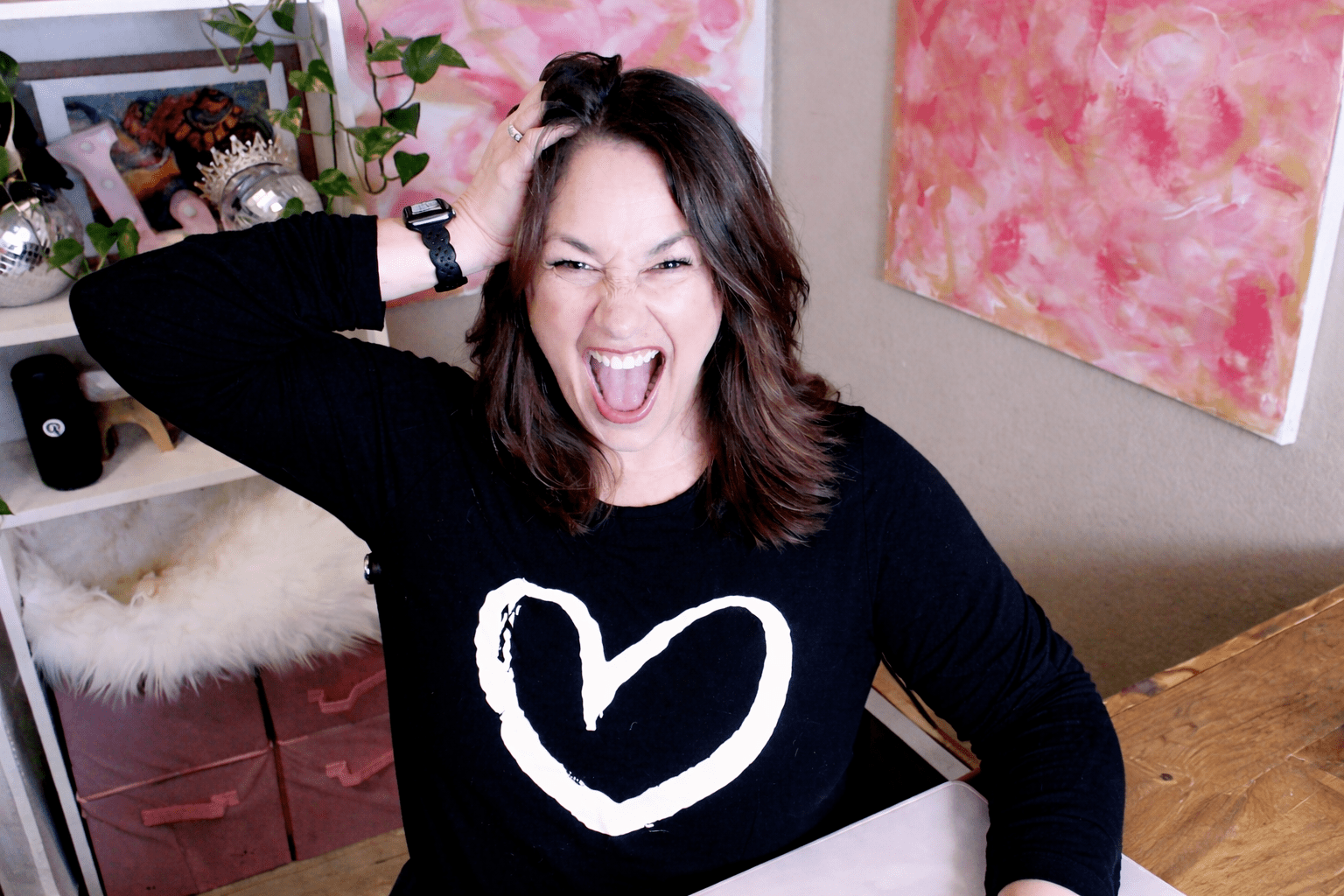
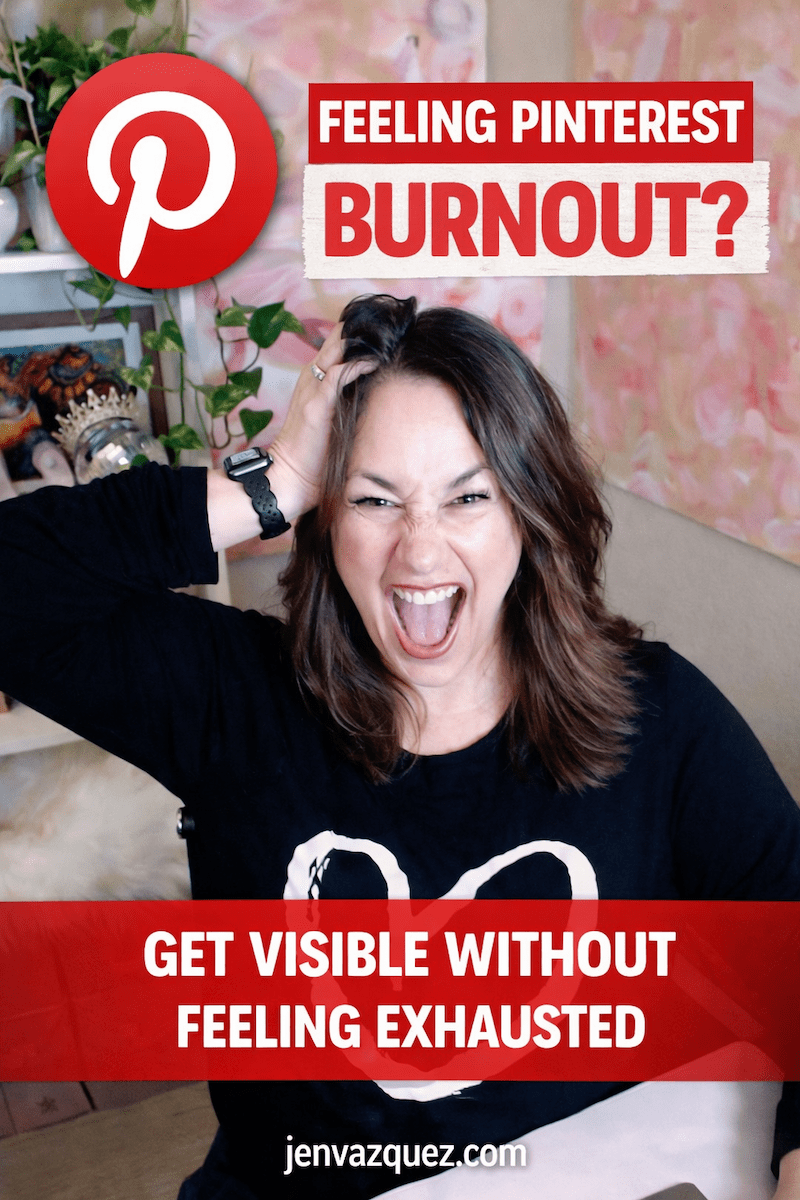
Jen Vazquez looking overwhelmed sitting at her desk in a black shirt with a white heart on it

Why Pinterest Feels Overwhelming (And How to Simplify Your Strategy)

If Pinterest feels overwhelming, I want to gently say this:

It’s probably not Pinterest.

I help service providers simplify their marketing so it actually fits their life. And Pinterest usually only feels hard when we’re unclear — not when the platform is complicated.

Let’s break this down.

Pinterest Feels Overwhelming When Your Message Isn’t Clear

Pinterest becomes heavy when you don’t know your main message.

When you’re posting too many types of content.

When your account talks about five different things.

Clarity removes pressure. Confusion creates it.

Pinterest works best when you solve one clear problem for one clear person in a relatable way. That’s it. That’s the whole thing.

Trying to Follow Every Tip Makes It Worse

Pinterest education is everywhere.

And even something I shared last year might not apply today. The platform changes.

So when you hear rigid advice like:

  • “You need six pins per post.”
  • “You must post three times a day.”
  • “You have to follow this exact formula.”

Pause.

Numbers are guidelines, not rules.

For example, creating three to five pins for one blog can make sense — because you’re targeting different ideas within that post. But your account will need what your account needs.

No two businesses are the same.

Pinterest Isn’t the Problem. Your System Is.

If Pinterest feels like one more thing on your plate, you’re not alone. Most service providers don’t need more ideas — they need a simple plan that fits into real life. Pinterest can drive steady traffic to your site without daily posting, trends, or burnout. You just need to know what to focus on (and what to ignore). Inside The Club, I’ll show you how to turn Pinterest into a calm, clear traffic source that works in the background — so you can get leads without feeling overwhelmed.

The Platform Isn’t Asking for More — It’s Asking for Clarity

Pinterest isn’t demanding more content.

It’s asking for focus.

When you narrow your niche, refine your message, and stop pivoting constantly, the platform actually gets easier.

If Pinterest feels heavy, it’s usually a sign your strategy needs narrowing — not expanding.

Overwhelm Isn’t a Motivation Problem

Overwhelm isn’t about discipline.

It’s about decisions.

When you’re unclear about who you’re speaking to or what you’re known for, every content decision feels harder.

But when your message is clear, your marketing gets lighter.

That’s the shift.

📌 DON’T FORGET TO PIN IT!
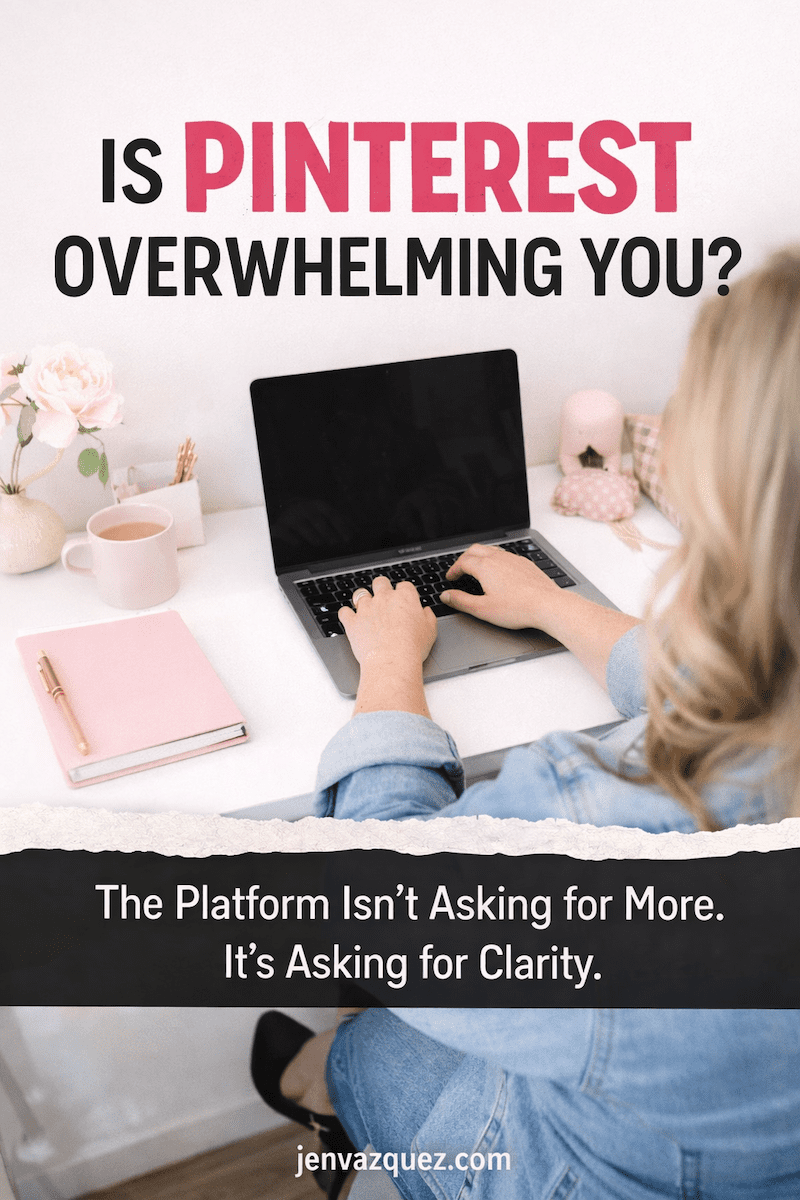
Female business owner at a desk typing on a labtop while thinking about her Pinterest marketing strategy.
Woman holding her hair in frustration at a pink home office desk representing Pinterest overwhelm and marketing confusion.
Business owner reacting dramatically at her desk, symbolizing frustration with Pinterest marketing confusion.

Why Pinterest Feels Slow (And Why That’s Actually a Good Sign for Your Business)

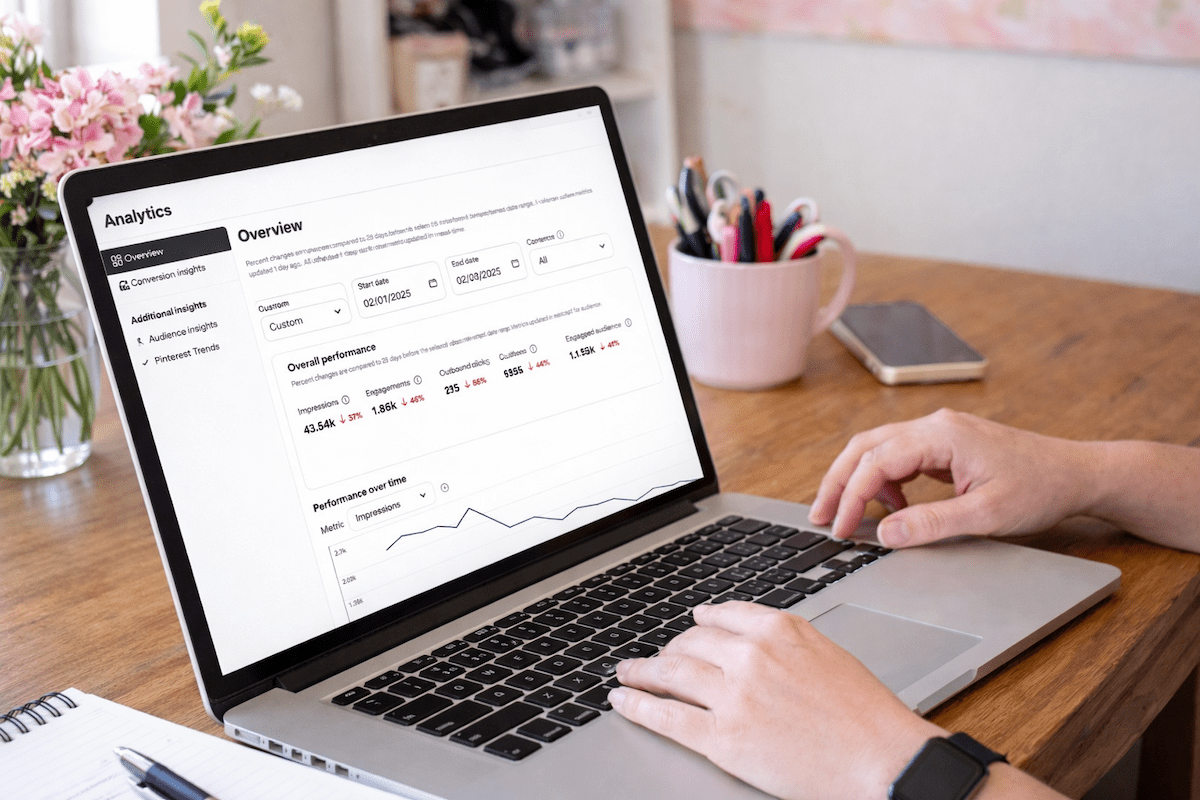
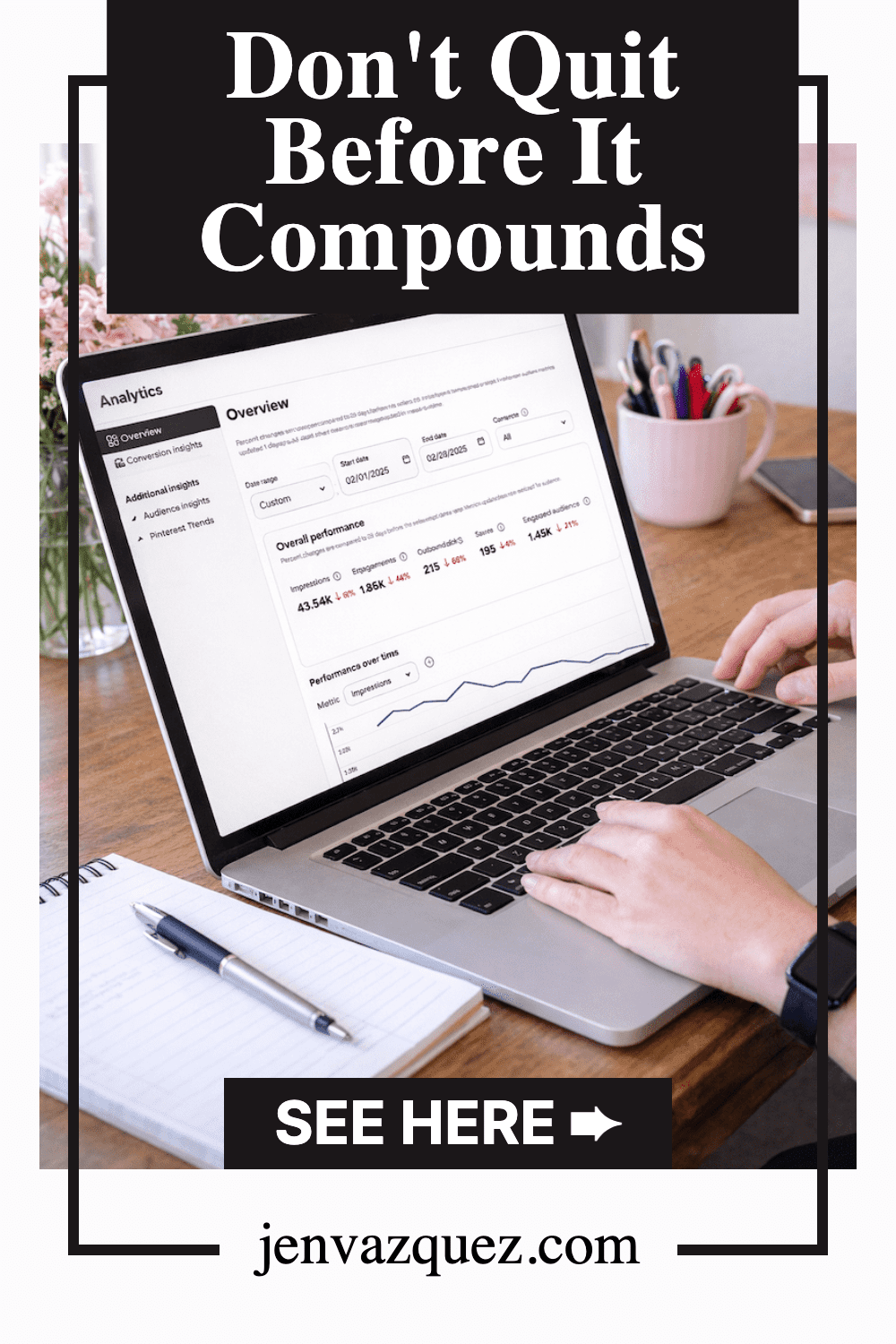
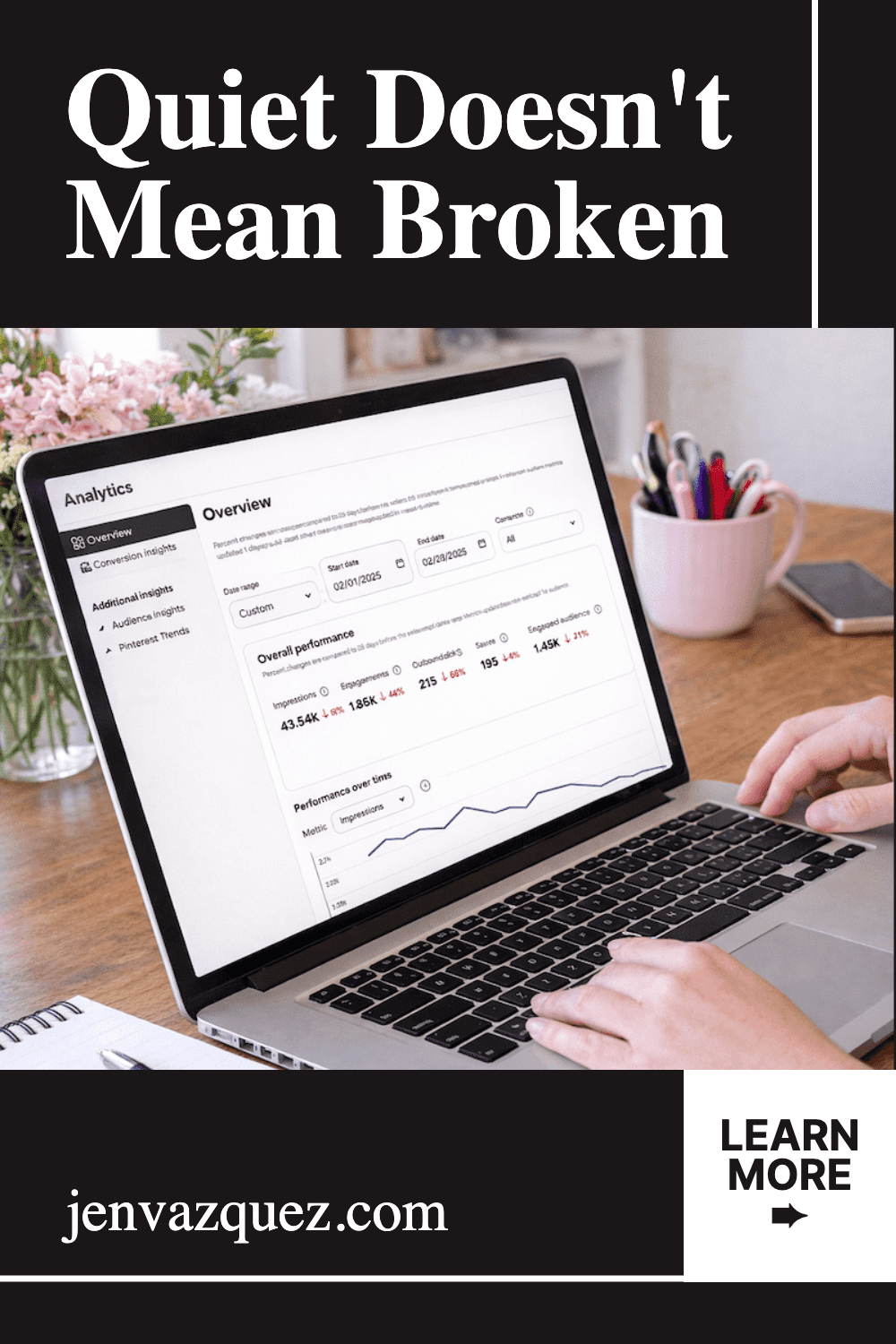
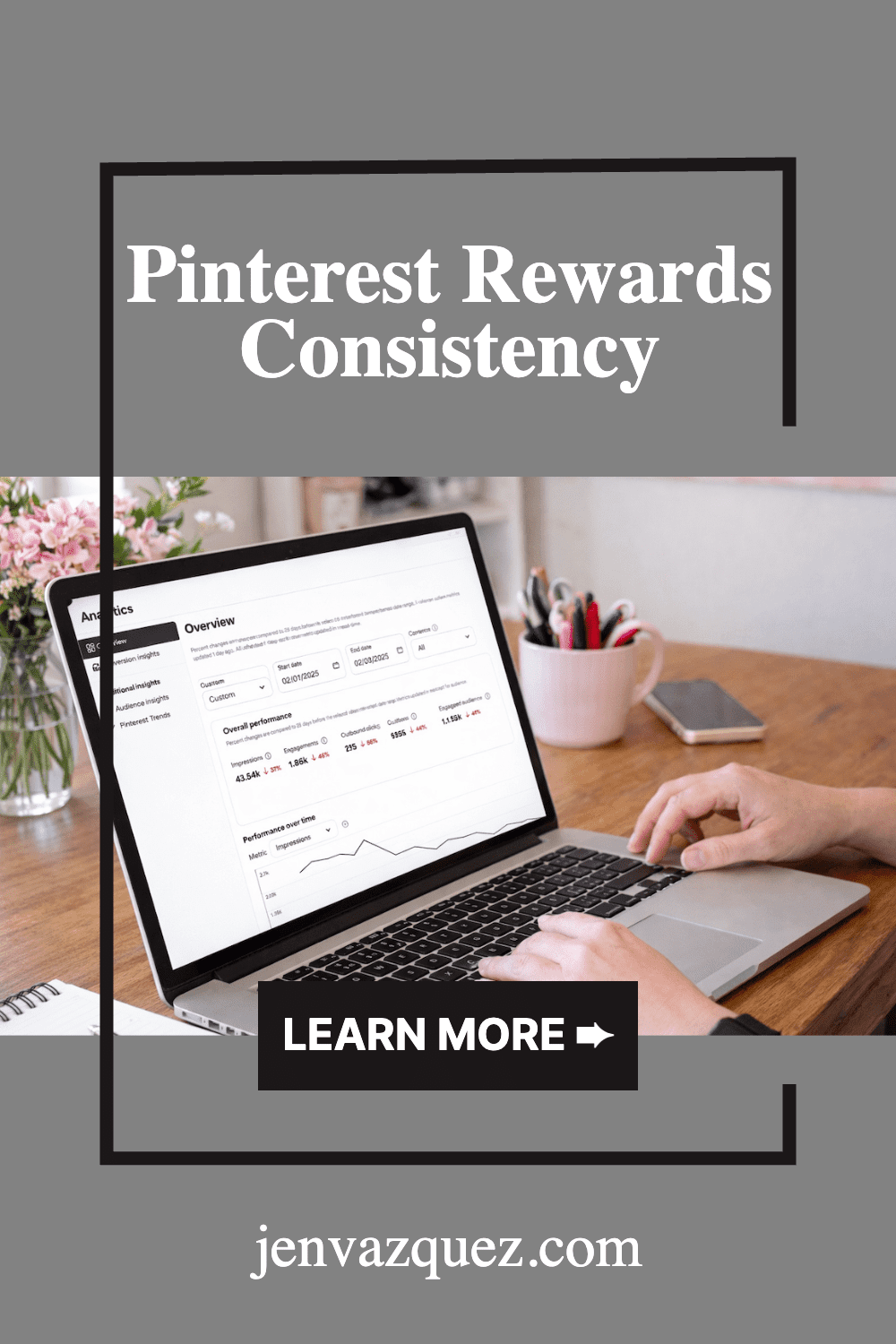
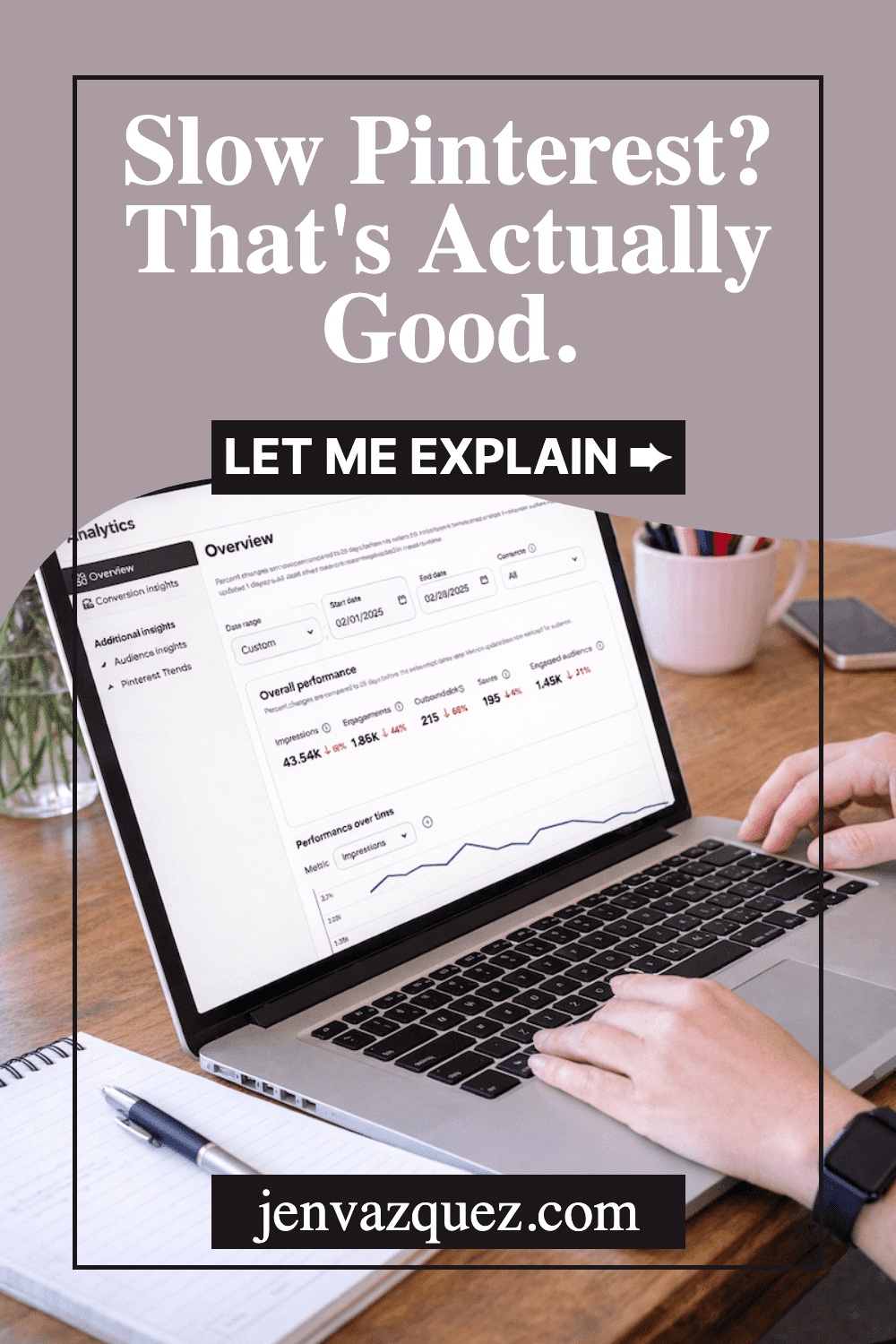
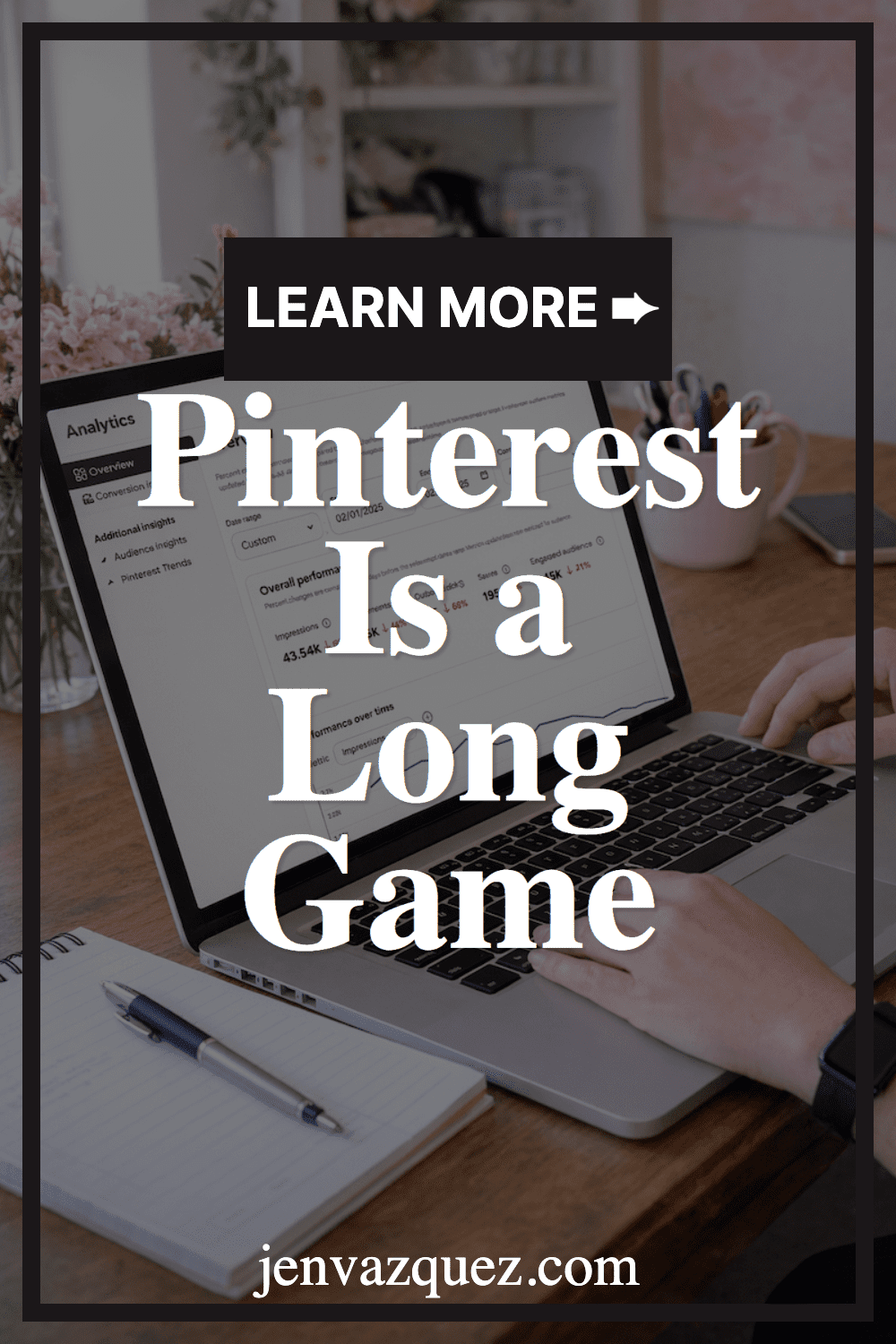
Pinterest analytics on a laptop illustrating long-term Pinterest growth and performance trends

Why Pinterest Feels Slow (And Why That’s Actually a Good Sign for Your Business)

If Pinterest feels quiet right now, I want you to hear this loud and clear: that doesn’t mean it’s broken. And it definitely doesn’t mean you’re doing anything wrong.

This is one of the most common moments where people start second-guessing everything. And it’s usually the exact moment they quit Pinterest… right before it starts working.

Hey, I’m Jen Vazquez. I help service providers use Pinterest in a way that actually leads to clients — not

Pinterest Is Not Instant Feedback (And That’s the Point)

Pinterest isn’t social media. I know I say that all the time, but it matters here.

Pinterest is a search marketing platform — just like YouTube. And search takes time.

When you post a pin, Pinterest doesn’t blast it out and judge it in 24 hours. It quietly tests it behind the scenes. It shows it to small groups, watches who saves it, learns what searches it belongs in, and gathers data.

That phase feels invisible. And honestly? That’s where most people get uncomfortable.

Quiet Does Not Mean Broken

Let’s reframe the silence.

Quiet doesn’t mean Pinterest isn’t working.
Quiet usually means Pinterest is learning.

And learning takes time.

This is why so many people quit Pinterest right before it starts working. They assume that if they don’t see fast results, it must not be worth the effort.

But Pinterest isn’t designed for urgency or panic. It’s designed for long-term visibility.

Feeling stuck or confused by your marketing?

My Marketing Coaching Calls are perfect if you want a second set of expert eyes on your strategy. We can look at Pinterest, walk through your analytics, simplify your marketing workflow, and get clear on your overall visibility — together on a private video call. You’ll leave with real clarity and a clear action list for what to do next.

Instagram Rewards Speed. Pinterest Rewards Consistency.

Instagram gives you instant feedback. You post something, and within minutes you know if it hit or flopped. Then 48 to 72 hours later? It’s gone.

Pinterest works differently.

Pinterest is more like a snowball rolling downhill. It starts small. It picks up a little traction. Then a little more. And over time, it turns into something that keeps working without you having to push every single day.

If you’re showing up consistently, talking about clear topics, and sending people somewhere helpful, you are building something — even if it feels slow right now.

Why Stopping Early Is the Real Mistake

The biggest mistake I see isn’t bad pins or wrong keywords.

It’s stopping too soon.

People assume silence means failure. So they quit. And they never get to the part where Pinterest actually starts compounding.

Pinterest is a long game. But it’s one that keeps paying you back — with traffic, leads, and visibility that doesn’t disappear overnight.

Build for the Long Term (Not the Spike)

If you want to understand how long-term visibility really works — not just on Pinterest, but across your entire marketing — I’d love to invite you to the Creative Marketing Summit 2026.

It’s our fourth year, Tailwind is sponsoring again for the fourth year in a row, and it’s a free online event built to help your marketing actually lead somewhere. Not just look busy.

You can grab your free ticket at creativemarketingsummit.com.

And if Pinterest feels slow right now? Stay consistent. Stay the course. Or reach out if you want help building a system that fits your real life.

fingers on a laptop keyboard with pinterest analytics on the screen | Why Pinterest Feels Slow (And Why That's Actually a Good Sign for Your Business) by Jen Vazquez Media

Case Study: Building an Evergreen Visibility System From Scratch

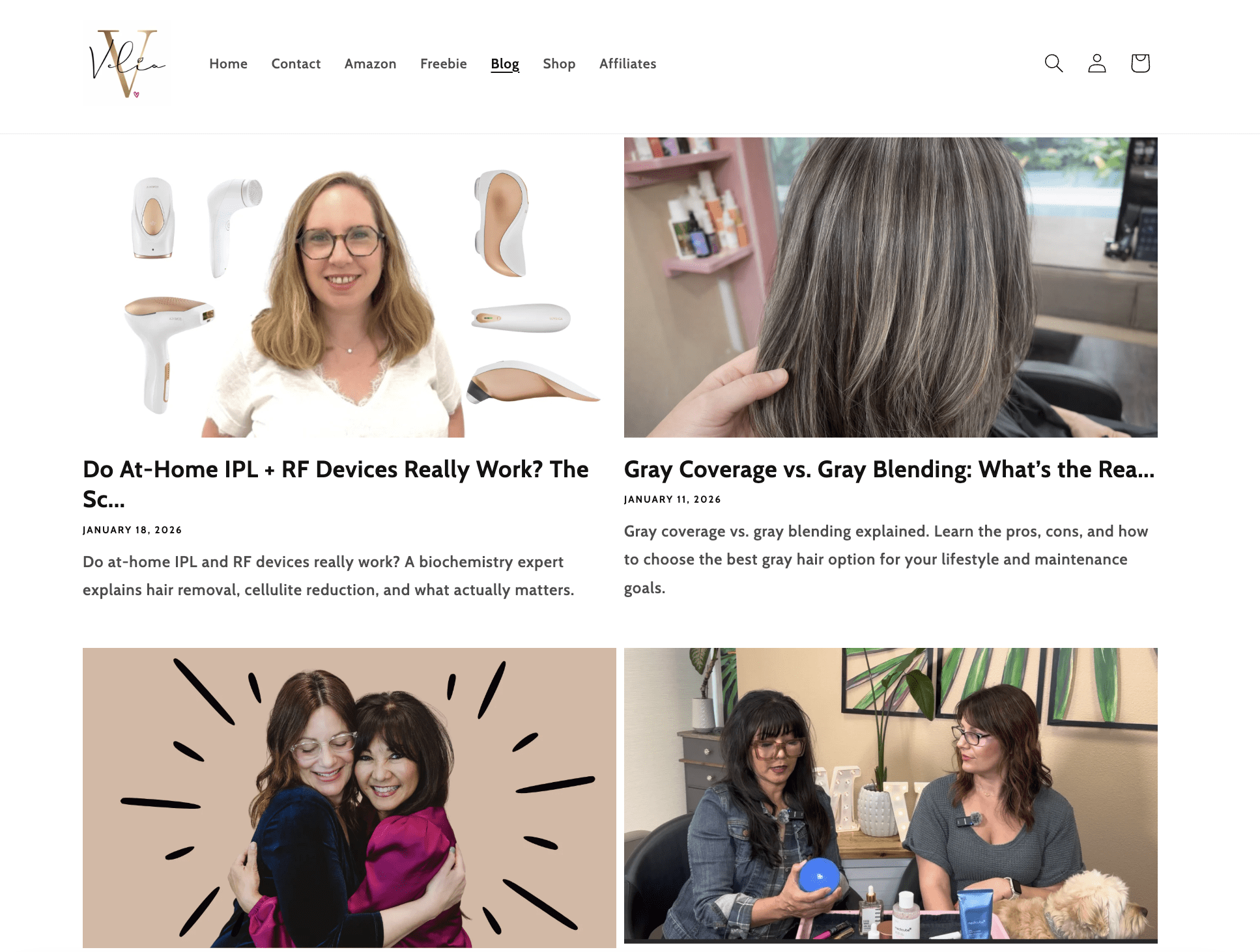
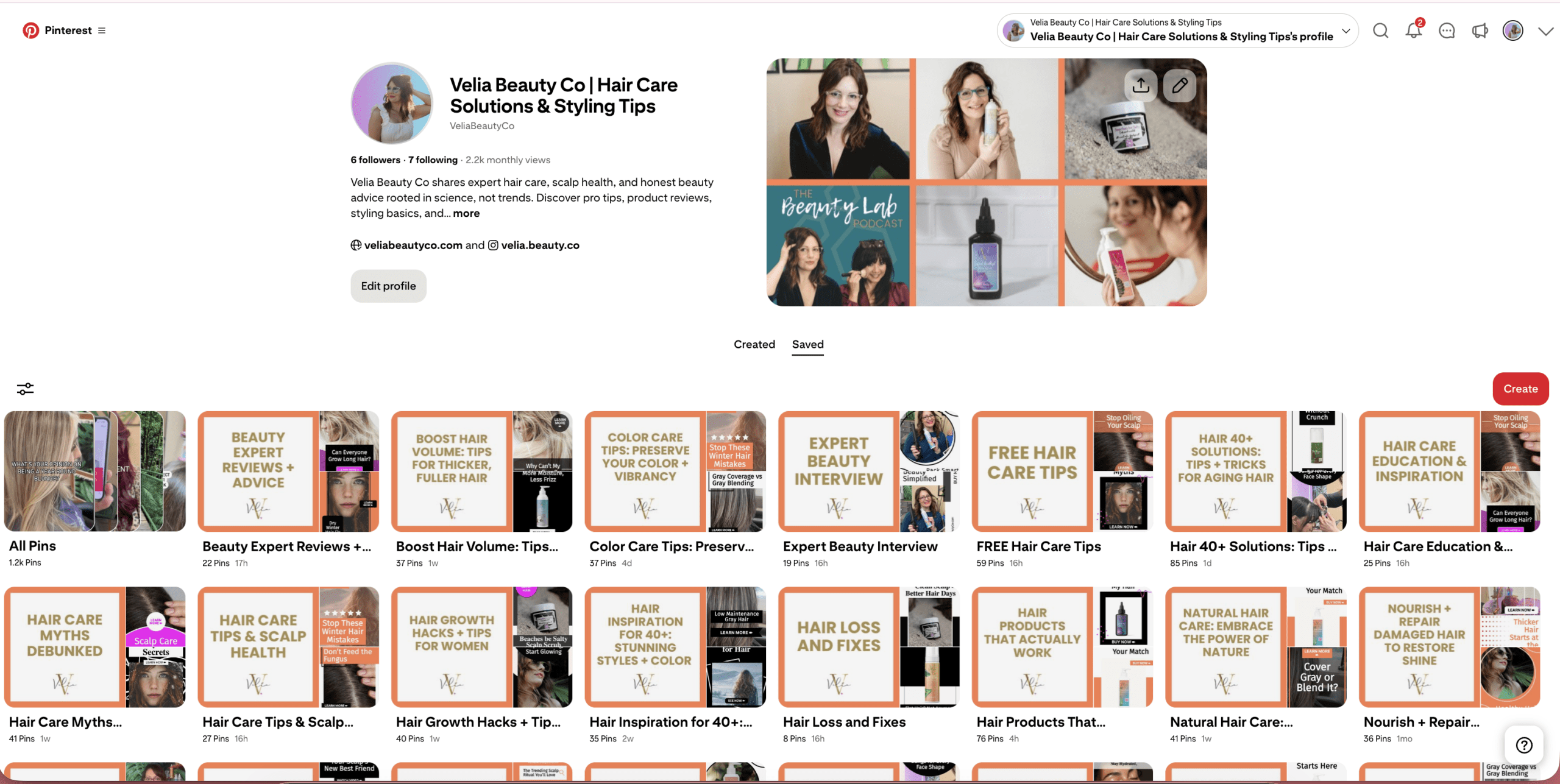
Case Study: Building an Evergreen Visibility System From Scratch by Jen Vazquez Media of Velia Beauty Co and Moderne Beauty and The Beauty Lab Podcast

Case Study: Building an Evergreen Visibility System From Scratch

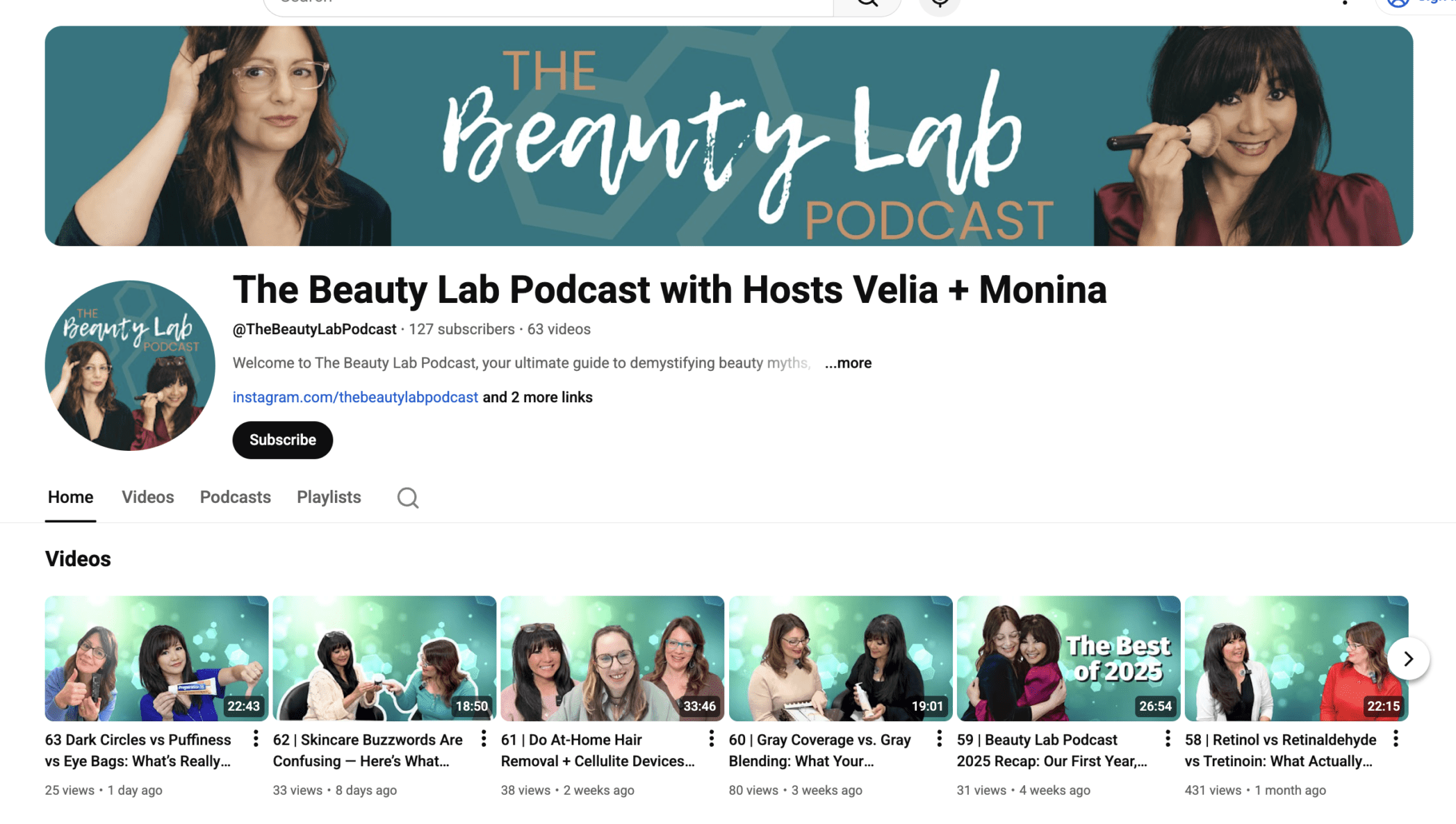
Velia Beauty Co + The Beauty Lab Podcast

Client Snapshot

Client: Velia Beauty Co + The Beauty Lab Podcast
Industry: Beauty + Hair Care
Project Scope: Podcast launch and management, YouTube launch and management, Pinterest marketing, email marketing, brand photography, full content repurposing
Agency: Jen Vazquez Media

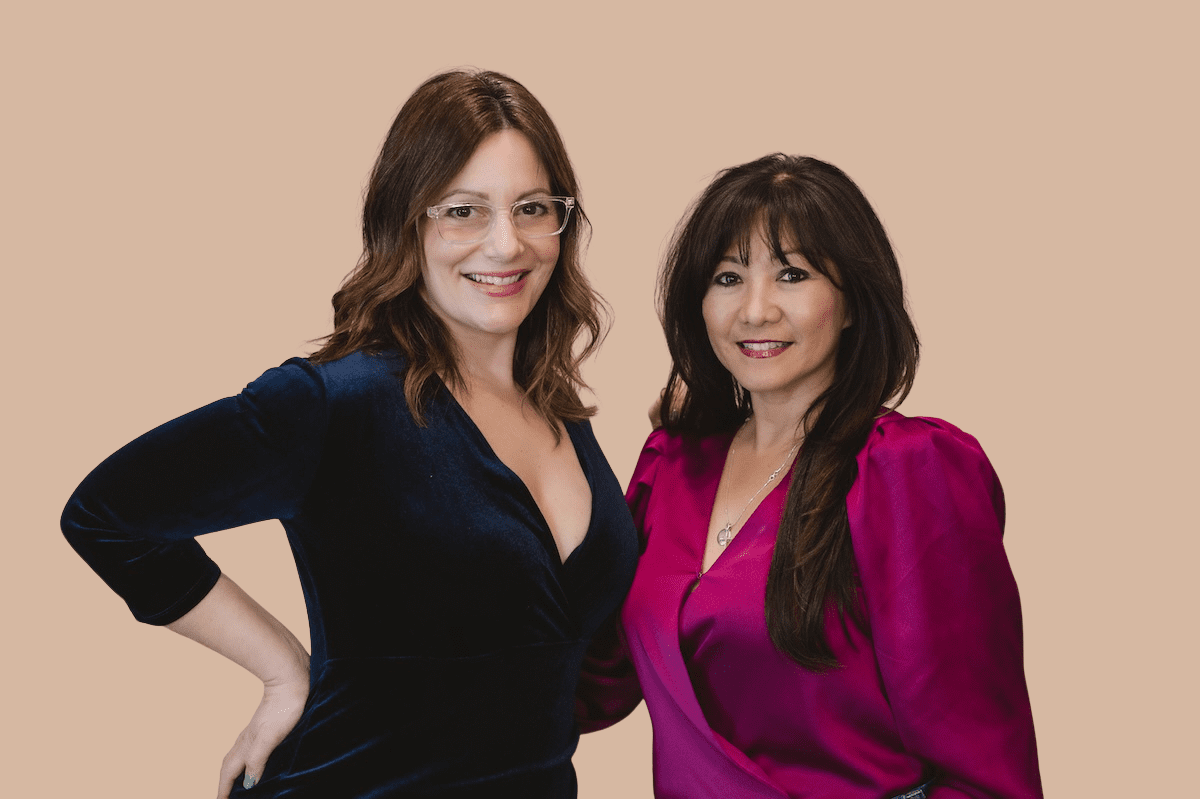
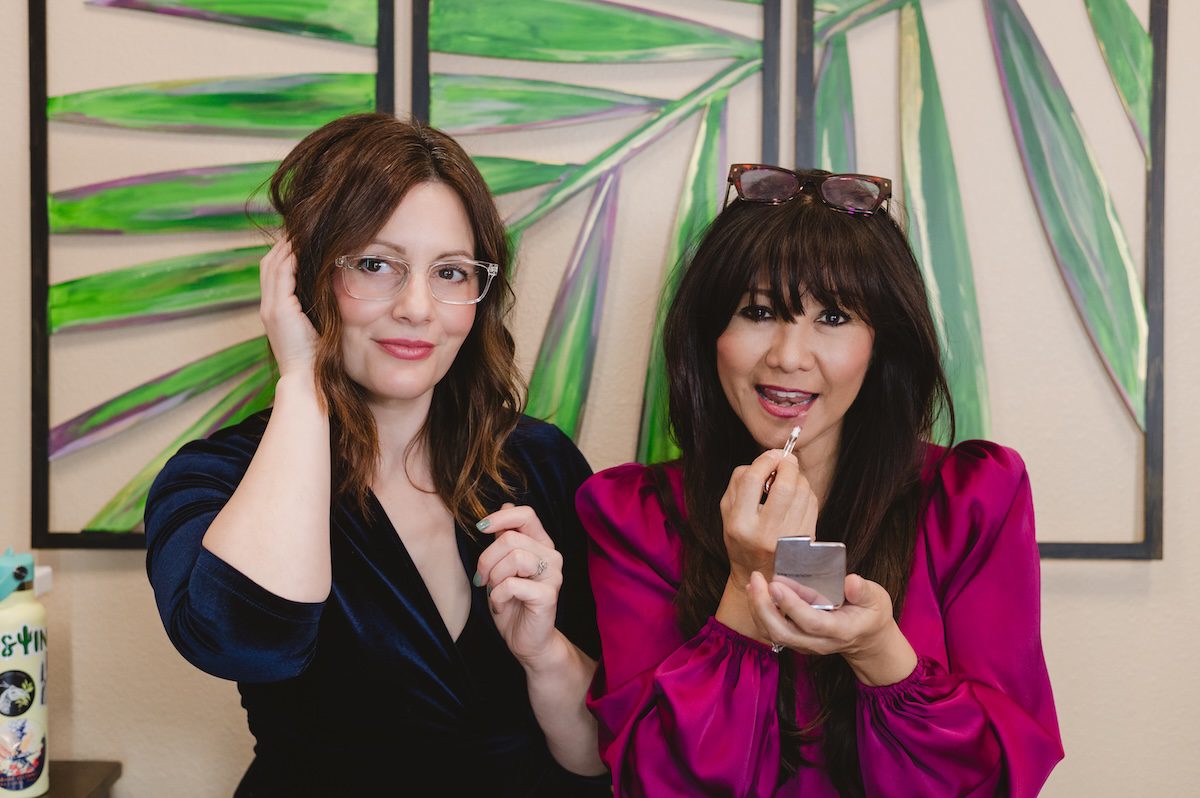
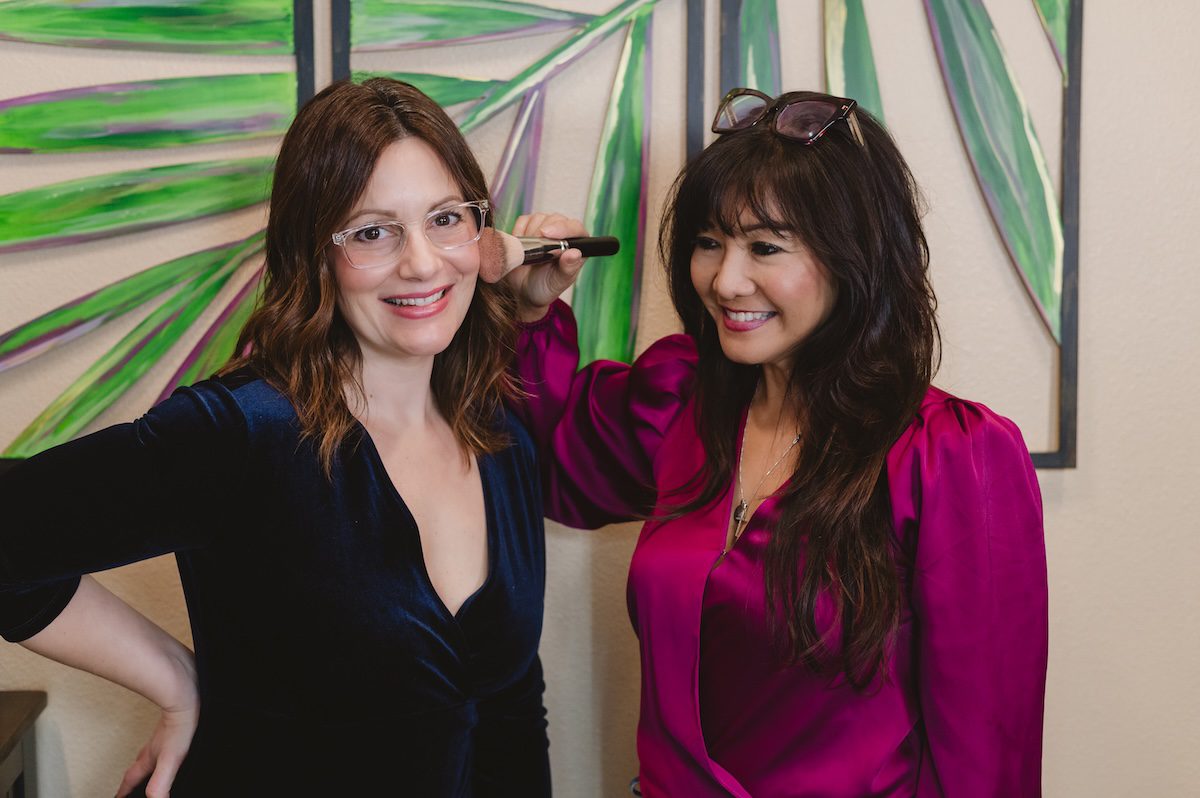
Velia Beauty Co is a hair care brand built on education, ingredient transparency, and real solutions for women navigating hair and scalp changes over time. Alongside her product-based business, Velia co-hosts The Beauty Lab Podcast with Monina — a show focused on demystifying beauty myths and answering the questions women are already searching for.

When Velia came to us, she wasn’t looking for more ideas.

She wanted a system.

Case Study: Building an Evergreen Visibility System From Scratch by Jen Vazquez Media (Marketing + Pinterest Agency)

The Starting Point: Built From Absolute Zero

When we started working together:

  • There was no podcast
  • There was no Pinterest account
  • There was no YouTube channel
  • There was no email marketing system
  • There was no repurposing workflow
  • There was no library of brand photos

Velia and her co-host knew early on that the only way they would stay consistent with the podcast was if someone else handled everything after recording.

They didn’t want to:

  • Learn marketing through free, disconnected content
  • Experiment with tools that wouldn’t be on brand
  • Spend time editing, uploading, writing, or scheduling

They wanted the podcast to become a discovery engine, not another responsibility.

The Goal: Visibility Without More Work

Velia was very clear about what she wanted:

  • Visibility without adding more to her plate
  • Consistency without burnout
  • Expert execution instead of DIY trial-and-error
  • A podcast that helped people discover both the show and her products

Her role needed to stay simple.

She and her co-host record the podcast.
That’s it.

Case Study: Building an Evergreen Visibility System From Scratch by Jen Vazquez Media (Marketing + Pinterest Agency)

Our Approach: One Recording → A Full Marketing Ecosystem

We built a complete, done-for-you visibility system from the ground up.

Podcast + YouTube Management

We:

  • Traveled on-site to help set up lighting and tech the first time they recorded, so recording felt easy yet still professional
  • And now we take the raw video
  • Edit each episode
  • Publish to all podcast platforms
  • Upload and optimize every episode on YouTube

Blog + Show Notes (Dual Publishing)

Each podcast episode is repurposed into:

Same core content, different positioning — without duplicate SEO issues.

Pinterest Marketing (Started From Scratch)

We:

  • Created the Pinterest account from zero
  • Built keyword-focused boards
  • Published pins weekly
  • Used podcast episodes, blog content, and her freebie as evergreen traffic drivers

Pinterest now works quietly in the background, continuing to surface its content long after episodes are published.

Email Marketing (Done-For-You)

After about a year of podcast and Pinterest growth, Velia decided she didn’t want to implement her weekly emails herself.

We:

  • Set up her email marketing system from scratch
  • Write and send weekly emails
  • Include The Beauty Lab Podcast content
  • Strategically feature Velia Beauty Co products to support sales

This created a clean path from education → trust → product visibility.

Brand Photography for All Platforms

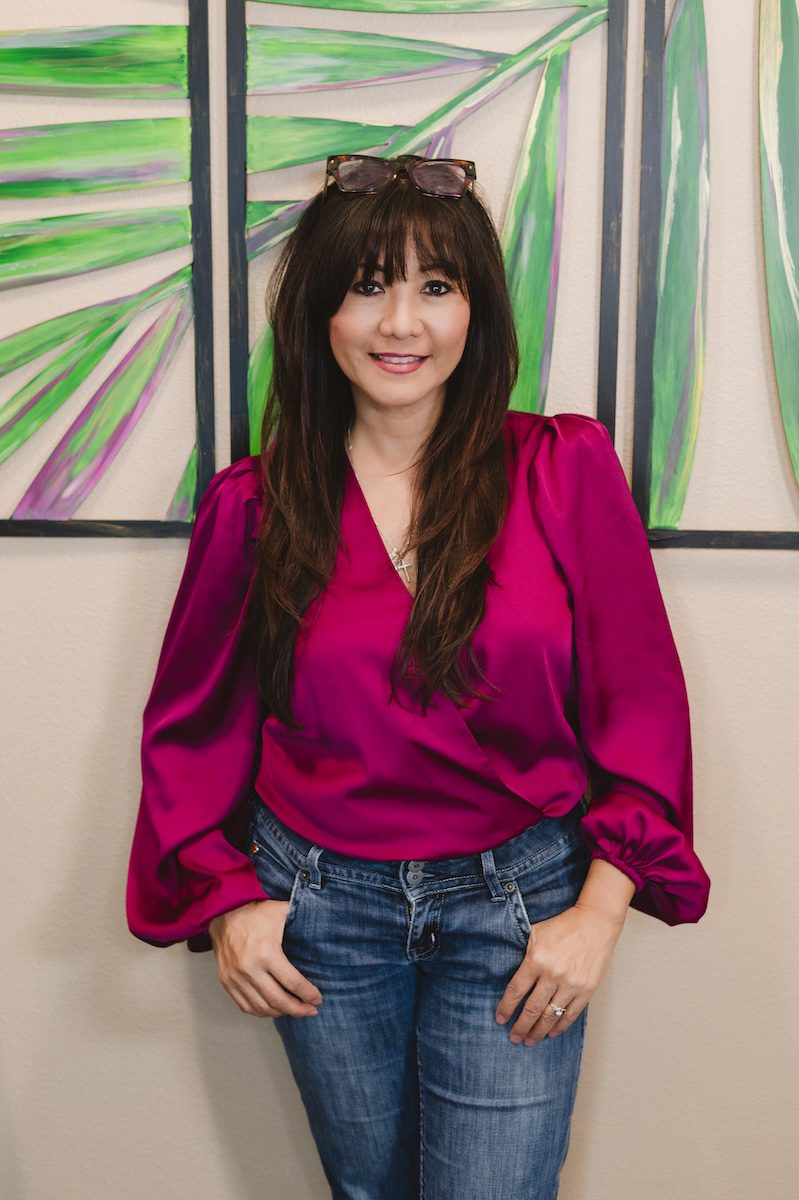
We also completed a brand photography shoot to create a cohesive image library for:

  • Website content
  • Blog posts
  • Pinterest pins
  • Podcast promotion
  • Email marketing

This ensured visual consistency across every platform and gave the brand a strong, recognizable presence wherever its content shows up.

Case Study: Building an Evergreen Visibility System From Scratch by Jen Vazquez Media (Marketing + Pinterest Agency)

The Results

Pinterest Growth (Built From Scratch)

Pinterest was launched with zero existing data, followers, or traffic.

Since starting and managing Pinterest for Velia Beauty Co, the account has experienced sustained, measurable growth:

  • Followers increased by 600%
  • Monthly viewers increased by 231,000%
  • Outbound clicks increased by 2,700%

Pinterest now functions as an evergreen discovery platform, consistently driving traffic to:

  • Blog content
  • Podcast episodes
  • Lead magnets and freebies

All without the need for daily posting or ongoing manual effort from the client.

Podcast Growth (Built From Zero)

The Beauty Lab Podcast launched with no existing audience and no prior episodes.

Today, the podcast shows steady, healthy growth driven by evergreen beauty education:

  • 336 downloads in the last 30 days
  • 758 downloads in the last 90 days
  • 2,576 total downloads
  • Strong listenership across Apple Podcasts and Spotify

Because episodes focus on searchable, education-based topics, they continue to be discovered well after publishing — supporting long-term visibility for both Velia and her co-host.

Email Performance (New Channel)

Email marketing was added later and also started from scratch.

Early performance includes:

  • 221 total subscribers
  • 39% average open rate
  • 1.65% average click rate

List growth is driven by:

  • A “greasy hair” free guide
  • Existing salon clients
  • Hair product customers

Even in the early stages, email is already supporting education, trust-building, and product awareness.

The Outcome That Matters Most

Velia and her co-host:

  • Record the podcast
  • Hand off the files
  • Everything else runs

Their content now:

  • Lives on multiple platforms
  • Is repurposed automatically
  • Continues working long after it’s published
  • Supports both brand visibility and product sales

No scrambling.
No guesswork.
No burnout.

Case Study: Building an Evergreen Visibility System From Scratch by Jen Vazquez Media (Marketing + Pinterest Agency)

Why This Works

This system isn’t about doing more content.

It’s about building one strong core asset — the podcast — and letting it power:

  • Blog content
  • Pinterest traffic
  • YouTube discovery
  • Weekly emails
  • Ongoing brand authority

One workflow.
Long-term visibility.
Marketing that fits real life.

Who This Is For

This type of system is ideal for:

  • Business owners who want visibility without more work
  • Podcast hosts who want consistency without burnout
  • Brands that want evergreen discovery instead of short-term spikes
  • Founders who want expert execution, not DIY overwhelm

About Jen Vazquez Media

At Jen Vazquez Media, I help female service providers simplify their marketing so it actually works — without needing more time, more content, or more hustle.

With over a decade of experience in marketing, Pinterest strategy, and brand photography, I focus on one thing: building clear, repeatable marketing workflows that bring in leads and fit real life. No guesswork. No spinning your wheels. Just systems that make sense and keep working in the background.

I believe marketing should feel supportive, not stressful. Whether you’re trying to get more eyes on your content, turn your blog into a traffic driver, or finally understand what to focus on each week, my work is about clarity, consistency, and ease.

If you’re tired of doing all the things and ready for a smarter way to show up, you’re in the right place.

Want help simplifying your marketing?

Explore DIY or Done With You services or free resources — and let’s make marketing feel doable again.

Case Study: Building an Evergreen Visibility System From Scratch by Jen Vazquez Media (Marketing + Pinterest Agency)
Case Study: Building an Evergreen Visibility System From Scratch by Jen Vazquez Media
Case Study: Building an Evergreen Visibility System From Scratch by Jen Vazquez Media  of Velia Beauty Co and Moderne Beauty and The Beauty Lab Podcast

📌 DON’T FORGET TO PIN IT!
Case Study: Building an Evergreen Visibility System From Scratch Vfor elia Beauty Co + The Beauty Lab Podcast

Why Brand Photography Matters More Than Ever for Marketing

Why Brand Photography Matters More Than Ever for Marketing by Jen Vazquez Media

Why Brand Photography Matters More Than Ever for Marketing

Hey friend — let’s talk about brand photography, but not from a trends or “what looks cute on Instagram” angle. I want to talk about it from a marketing point of view. Because those are two very different conversations.

I’ve been photographing businesses since 2009, and I’ve seen this play out again and again: the photos that look the best are not always the ones that work the hardest in your marketing. And let’s be real — we want our marketing to actually do something. Not just sit there looking pretty.

Marketing Platforms Don’t Reward Pretty — They Reward Clarity

Here’s the big shift I’ve seen, especially over the last few years: marketing platforms reward clarity, not aesthetics.

Clear visuals help people quickly understand who you are, what you do, and what it feels like to work with you. That matters more now than it did last year… and way more than it did a few years ago.

People are overwhelmed with content. Like, completely overloaded. They’re more careful with their clicks, more selective with their time, and more tuned in to who feels real, grounded, and trustworthy.

Your photos do a lot of that work before anyone reads a single word.

Your Photos Speak Before Your Words Ever Do

Before someone reads your caption.
Before they skim your website.
Before they decide to click, save, or move on.

Your visuals are already telling a story.

When your photos feel generic, overly styled, or disconnected from your message, people hesitate. They might not know why — but they feel it. Even if your strategy is solid. Even if your offer is good. Even if your words are on point.

That quiet hesitation matters.

Where Brand Photography + Videography Meet Real Marketing

At Jen Vazquez Media, brand photography and brand videography aren’t about creating “pretty content” for the sake of it. They’re about creating visuals that actually do a job in your marketing.

Every image and video we create is designed to support how your business shows up online — from your website and Pinterest to social media and sales pages. We focus on clarity first: who you are, what you do, and what it feels like to work with you. That way, your visuals aren’t just on-brand — they’re working behind the scenes to build trust, confidence, and connection before someone ever clicks or buys.

If you want visuals that feel natural, aligned, and built to support your full marketing strategy (not fight it), click below!

When Visuals Match the Experience You’re Selling

Now let’s flip it.

When your visuals actually match the result you’re selling — when they feel aligned with the experience someone wants — everything changes.

People stay longer.
They click with more confidence.
They read the whole caption.
They trust you faster.

This is true on Pinterest, your website, social media… everywhere your content lives.

Brand photography isn’t about having more photos of you. It’s about having the right photos. Photos that support your message. Photos that reinforce your offers. Photos that make your marketing feel connected instead of scattered.

Why Brand Photography Matters More Now Than Ever

Brand photography matters more now not because trends changed — but because people did.

They want clarity.
They want consistency.
They want to feel comfortable before they invest.

And your visuals are often the very first place that trust is built… or lost.

If you want to understand how visuals, strategy, and content actually work together — not as separate pieces, but as one connected system — that’s exactly what the Creative Marketing Summit 2026 is all about.

It’s a free online event at the end of February, designed for service providers who want marketing that doesn’t just look good, but actually supports their business.

You can grab your free ticket at creativemarketingsummit.com.

📌 DON’T FORGET TO PIN IT!